Solo Morning Routine for Dads When Mom Deploys
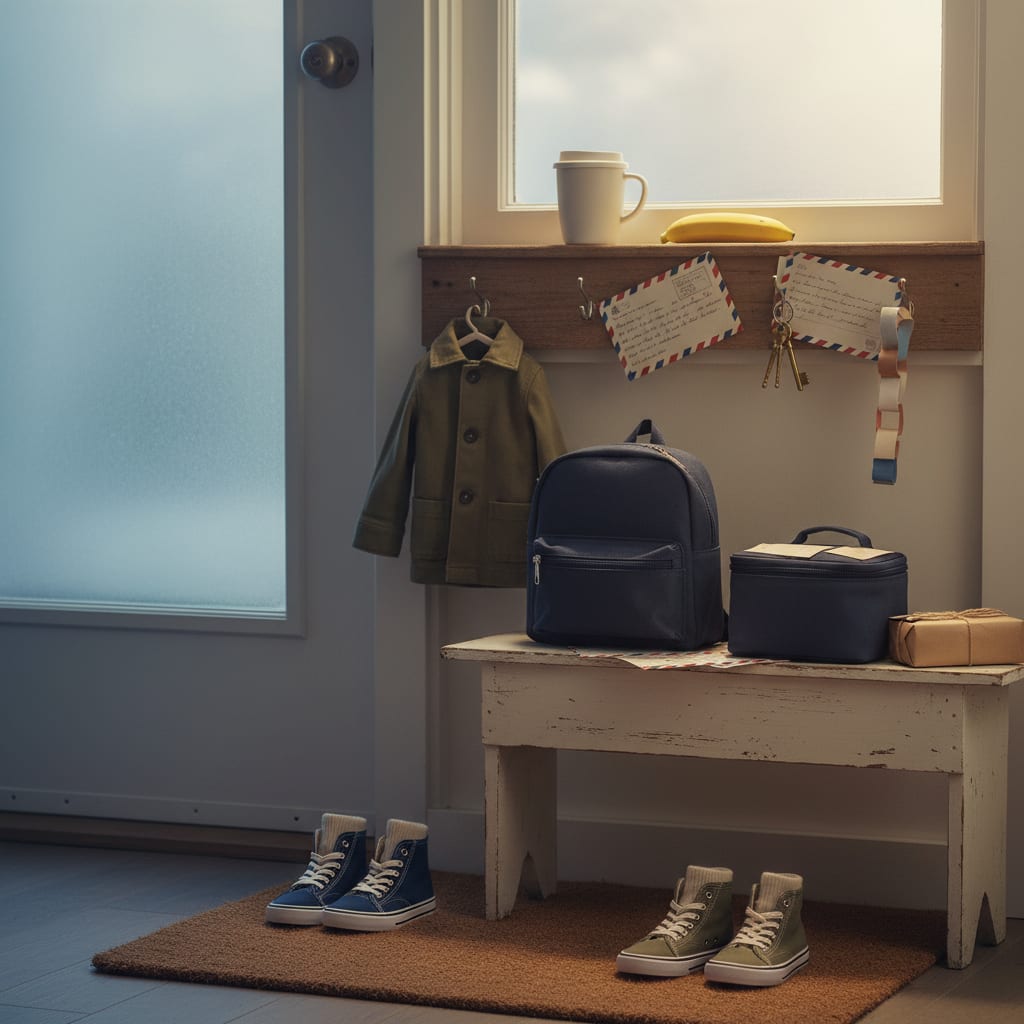
A solo morning with little kids is won the night before. Set out clothes, shoes, bags and breakfast while the house is quiet, then wake in stages instead of all at once — you first, then the slowest child, then the fastest — and put a fixed, unhurried goodbye at the end of drop-off. Cut every optional decision out of the hour: same breakfast, same order, same exit time. When mom is the one deployed, expect the mornings to carry an emotional load the evenings usually take, and plan the clock around that rather than around efficiency.
When mom is the one who deployed
Most of the homefront material assumes the dad left. Plenty of us are on the other side of it — holding the house while the kid’s mother is the one gone — and the mechanics are identical while the social experience is not.
Two things are different in practice. The first is that people will assume you’re covering temporarily. You will be asked, kindly, whether you’re “on daddy duty this week” by someone who means nothing by it, and you will hear it fourteen more times before Christmas. The second is administrative: forms, group chats, school contacts and pediatric offices are often still routed to mom by default, and if she set them up, they’re in her email. Spend one evening in week one moving primary contact to you across school, childcare, medical and the emergency card. It is the highest-value hour of the whole absence.
What is not different is the kids’ experience. A missing parent is a missing parent, and the run-book for it is the same one in solo parent bedtime during deployment — read with the pronouns swapped.
Do tomorrow’s work tonight
Anything that can be decided in advance should be, because at 6:40 a.m. you have no judgment left to spend and a four-year-old with strong opinions about socks.
- Clothes out, including yours. Full outfits, socks inside shoes, by the door. Kids get a choice of two, made the night before, when you have the patience for a negotiation.
- Bags packed and staged. Daycare bag, school bag, your bag, all at the exit. Nothing “just needs one more thing in the morning.”
- Breakfast pre-decided. Not a menu — a default. Same thing four days a week is a feature.
- Bottles and cups filled and in the fridge. Two minutes at 9 p.m. saves five at 7 a.m., and the 7 a.m. minutes are worth more.
- The paperwork triage. Forms signed, permission slips in the bag, the thing you keep forgetting handled while it is only slightly annoying.
The reason to be rigid about this is that a solo morning has no slack. With two adults, one absorbs a spilled bowl while the other keeps the clock. Alone, one spill spends your entire buffer, so the buffer has to be built the night before instead.
Wake in stages, not all at once
The single biggest upgrade to a solo morning is refusing to have everyone awake simultaneously.
Get up before the house does — fifteen minutes is enough for coffee and boots on. Then wake the slowest child first, because slow children need runway and fast children need supervision. A kid who takes twenty-five minutes to get dressed gets woken twenty-five minutes out; the one who dresses in four gets woken later, on purpose, so there’s less time available for chaos.
For babies and toddlers who wake on their own schedule, the stagger runs the other way: get the pre-schooler moving while the baby is still down, so the baby’s wake-up meets a house that is already halfway out the door.
Then hold the same order every day. Bathroom, clothes, breakfast, teeth, shoes, door — whatever your sequence is, don’t reshuffle it. Kids under six run on order, not on time. They cannot tell you it’s 7:15; they can absolutely tell you that shoes come after teeth, and a child who knows what’s next stops asking you what’s next.
Drop-off, and the goodbye inside the goodbye
Drop-off during a deployment is not the same as ordinary drop-off, and pretending otherwise costs you.
For kids whose other parent is gone, being handed over to another adult is a repeat of the departure. That’s why an otherwise cheerful three-year-old can melt at a door she walked through happily in March. The fix is the same as any good goodbye: short, warm, scripted and identical every time. Say the same line, do the same physical thing — one hug, one high five, one wave from the same window — and then go. Long goodbyes are not gentler, they are just longer, and they teach a kid that the exit is negotiable.
Tell the teacher or caregiver that a parent is deployed. Not for sympathy — for coverage. Someone who knows will read a bad Tuesday correctly instead of writing up a behavior note, and will usually tell you what they saw at pickup.
If the wobble persists for weeks or shows up as a broader change in sleep, that is the separation showing up on a different clock; the patterns are in deployment sleep problems in kids.
When the wake-ups start creeping to 5 a.m.
Halfway through an absence, mornings often start earlier and earlier, and it is tempting to read every early wake-up as grief.
Sometimes it is. Often it’s arithmetic. Early rising is usually the most schedule-driven problem in a small kid’s day, and it responds to nap timing and bedtime far more than to reassurance — Betteroo’s rundown of why a baby wakes up too early and what actually moves it is the sanity check I’d run before assuming it’s emotional.
Two practical levers. Make the room genuinely dark, because a 5 a.m. summer sunrise is a wake-up call nobody scheduled. And give the kid a signal they can read without you: a ready-to-rise clock like the LittleHippo Mella turns “is it morning yet?” into a color on a nightstand, which is the difference between a child who waits and a child who comes to find out. It will not fix a genuinely overtired kid — move bedtime earlier before you buy anything.
Build a bench before you need one
Solo mornings fail on the day you’re sick, the car won’t start, or duty starts two hours early.
Line up the backup while things are calm: a neighbor who can take one kid to school, another family doing the same run, a childcare provider who does drop-in, and a written list of who is authorized to collect your kids. Make the ask specific and small — people say yes to “can you take Ellie on Thursdays if I’m called in early” far more readily than to “let me know if you can ever help.” The case for building that network deliberately, and early, is in the military extended family.
FAQ: solo mornings with a deployed mom
What time should I get up if I’m solo with young kids?
Fifteen to twenty minutes before the first child, consistently. You are not buying leisure, you are buying the ability to start the morning as an adult who has had coffee rather than one being woken up. Getting up an hour early to “be productive” usually costs more in lost sleep than it returns.
How do I stop the meltdown at daycare drop-off?
Keep it short, identical and cheerful, hand over to the same person where you can, and tell staff there’s a deployment on. Most drop-off crying stops within a few minutes of your leaving — ask the caregiver to text you once it’s over, and believe them.
Should mom call in the mornings from deployment?
Only if it’s reliable and it fits the clock. A call that arrives at random is a coin flip, and a shoe-hunt interrupted by a video call rarely improves either. A recorded good-morning message the kid can play on demand beats an unpredictable live one every time.
How long until solo mornings feel normal?
Usually a couple of weeks for the routine and longer for the feelings. If the sequence is still collapsing after a month, the problem is nearly always too many decisions left in the morning — move more of them to the night before.