Bedtime at a Relative's House Between Duty Stations
If you are living at a parent’s or sibling’s house between duty stations, run bedtime as a guest, not as a tenant. Ask your hosts for three things only — darkness, steady sound, and a boundary the kid can’t walk through — hold the safe-sleep rules absolutely, brief the adults once on the two or three things that actually matter, and let every other difference go. A PCS gap spent at family costs far less sleep than the same gap in lodging, provided you decide up front which lines are lines.
Someone else’s house is not temporary lodging
Plenty of military families land at a relative’s house between duty stations, and nobody plans for it, because it doesn’t feel like housing. It feels like a long visit — then it turns out to be seven weeks. A report date lands before housing does, one parent goes ahead to find a place, a kid finishes a school year.
It is a different problem from temporary lodging, and the difference isn’t square footage. In TLF you have no comfort and total authority: nobody has an opinion about your sound machine. At your mother-in-law’s you have a kitchen, a yard, help with the kids, and no authority at all: no holes in walls, no making the house quiet at 8:30, and two extra adults who love your child and hold long-standing views on how children sleep. Usually a fair trade — it just makes this a social plan as much as a sleep plan.
Ask your hosts for three things, not fifteen
The instinct on arrival is to apologize your way through a long list of requests. Don’t — long lists get negotiated down, short ones get granted. Ask for three:
- Dark. Blinds, a heavy curtain, or permission to hang something over the window. Most guest rooms are lit like a den at 6:30 in July.
- Sound. A machine running all night, at a volume the rest of the house will hear through the door. Betteroo’s rundown of how loud a sound machine should be and where to put it is worth ten minutes before you set one up behind a thin door.
- A boundary. A door that closes, or something that works like one. People forget this one, and it decides whether bedtime runs twenty minutes or ninety.
Everything else — mealtimes, the TV, the dog, the thermostat — is negotiable, and say so out loud: that’s what buys you the three. What you owe back is mostly noise. Someone in your party will be up at 5:40, so decide where that kid goes before it’s your host’s hallway.
Where the baby sleeps is the one thing that doesn’t bend
Everything above is negotiable. This isn’t — and a relative’s house is where it comes under pressure, not from carelessness but from love and a thirty-year gap in guidance. The offers are kind: a family crib in the basement, a nest of quilts somebody made, “he fell asleep on me on the sofa and he was fine.” NIH’s Safe to Sleep program is blunt on all three: a baby’s sleep surface should be “firm (returns to its original shape quickly if pressed on), flat (like a table, not a hammock), and level (not at an angle or incline) and covered only with a fitted sheet,” and “babies should never sleep on an adult bed, couch, or armchair by themselves, with others, or with pets.” Pillows, stuffed toys, crib bumpers, quilts and loose blankets stay out.
So the answer to the heirloom crib is that the baby sleeps in the thing you brought, every night — said once, warmly, before it becomes a 9 p.m. conversation with an audience. If you’d rather point at something than assert a rule personally, Betteroo’s walkthrough of what a safe sleep space is supposed to look like sends well ahead of your arrival.
Building a sleep corner in a room with no door
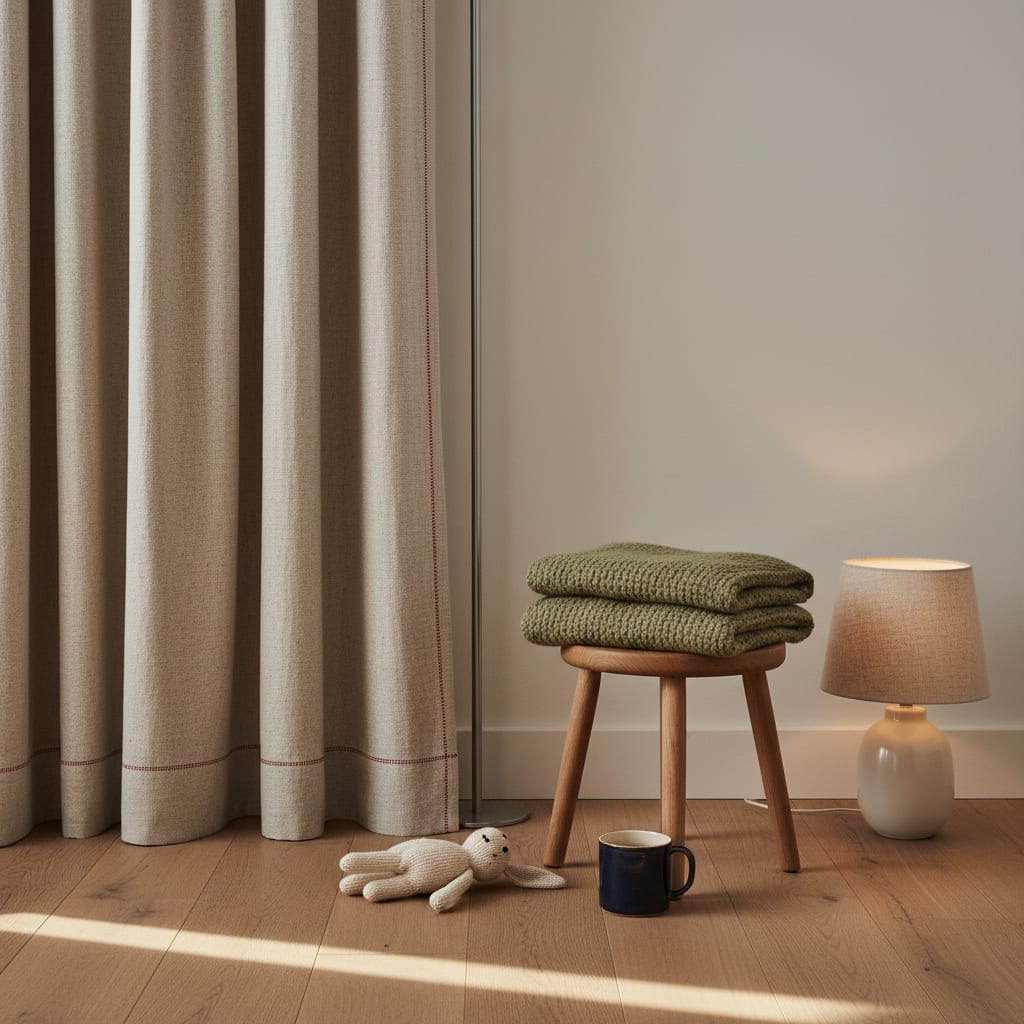
Often the space you’re given isn’t a bedroom — a finished basement, a landing, a den with a wide opening. Two problems follow: light and sightlines. Light you fix with a blackout panel that suctions to the glass. Sightlines are harder, and a floor-to-ceiling tension rod with a heavy curtain is the fix for a house you can’t drill: something like SUNALLY’s no-drill room divider rod tensions floor to ceiling, takes a curtain, and comes down leaving nothing behind. It won’t block sound; it blocks the two-year-old who can see the kitchen.
Put the corner furthest from household traffic and keep it single-purpose — the failure mode is a sleep spot doubling as the toy area, the suitcase area and the laundry table. The longer-stay version is in rebuilding a sleep corner when lodging runs long.
Brief the grandparents once, then let the small stuff go
This is the part that saves the most sleep, and it’s entirely about adults. Pick two or three non-negotiables and say them once, in daylight, as requests: bedtime is around this time, the last twenty minutes are just one of us, and once he’s down we don’t go back in for a chat. Then let the rest go — the third dessert, the Saturday half hour, the game Grandad invented involving the stairs. What matters is the bedtime with four adults in the doorway, all delightful, none leaving. Two hours of goodnight is not a discipline problem; it’s an audience problem.
Expect reversion, too: the four-year-old who has dressed himself for a year suddenly cannot. Most of it evaporates within a fortnight of your own address, so don’t build a program around it. The case for treating family as infrastructure is in building a military extended family.
When the household’s clock and your kid’s clock disagree
Your hosts have run their evenings the same way for twenty years: dinner at 7:30, television until ten, the dishwasher under the room your kid sleeps in.
Move the kid, not the house. Bedtime may land half an hour later than it did at your last duty station, and over a stay of weeks that’s fine — a consistent 7:50 beats a 7:15 relitigated nightly. Hold the sequence and the wake-up time, let bedtime float, and fix the clock once you have your own walls — that’s what the week-by-week reset is for. Sound machines, for the record, solve dishwashers. They do not solve a relative who wants to say goodnight properly at 8:15.
What you don’t let become the routine
The exit matters more than the stay: whatever forms here gets unwound in a house you haven’t seen yet. Three things worth guarding:
- Where they fall asleep. Start every night in an adult bed at Grandma’s and that is the routine — you’ll be undoing it in week one of unpacking.
- Who puts them down. Rotating four adults through bedtime feels generous and reads to a small child as a lottery. Keep it to the one or two you’ll have later.
- How many adults are in the room. Its own line, because it’s the one nobody notices happening.
Give the last fortnight of the stay to walking those back.
FAQ: bedtime at a relative’s house during a PCS
How long can we stay before this becomes a problem? Two to three weeks is a holding pattern; past that, treat it as an address and build a real sleep corner. Socially, agree an end date out loud early — even a soft one.
Our hosts think we’re being rigid about the crib. What do we say? Say it once, kindly, and attribute it rather than defending it personally — the guidance changed after they raised their kids. Don’t relitigate it. Raising it before you arrive beats night one.
My spouse went ahead to the new station. Will my kid connect that with moving? To a small child those are one event, not two, and it surfaces as clinginess rather than as a question. Name them separately and repeatedly: this is where we’re staying, this is where Dad is, this is when we’ll all be in one house.
What if nobody sleeps for the first three nights? Normal. Hold the sequence and the sleep surface, and solve nothing until night four — most of it is a kid in a strange room.
Still fighting bedtime in a house that isn’t yours? Betteroo builds a plan around the child you’ve got and the situation you’re in — for a lot of us, a spare room and a report date. Take the two-minute quiz.