Geo-Bachelor Dad: Staying Present From Another State
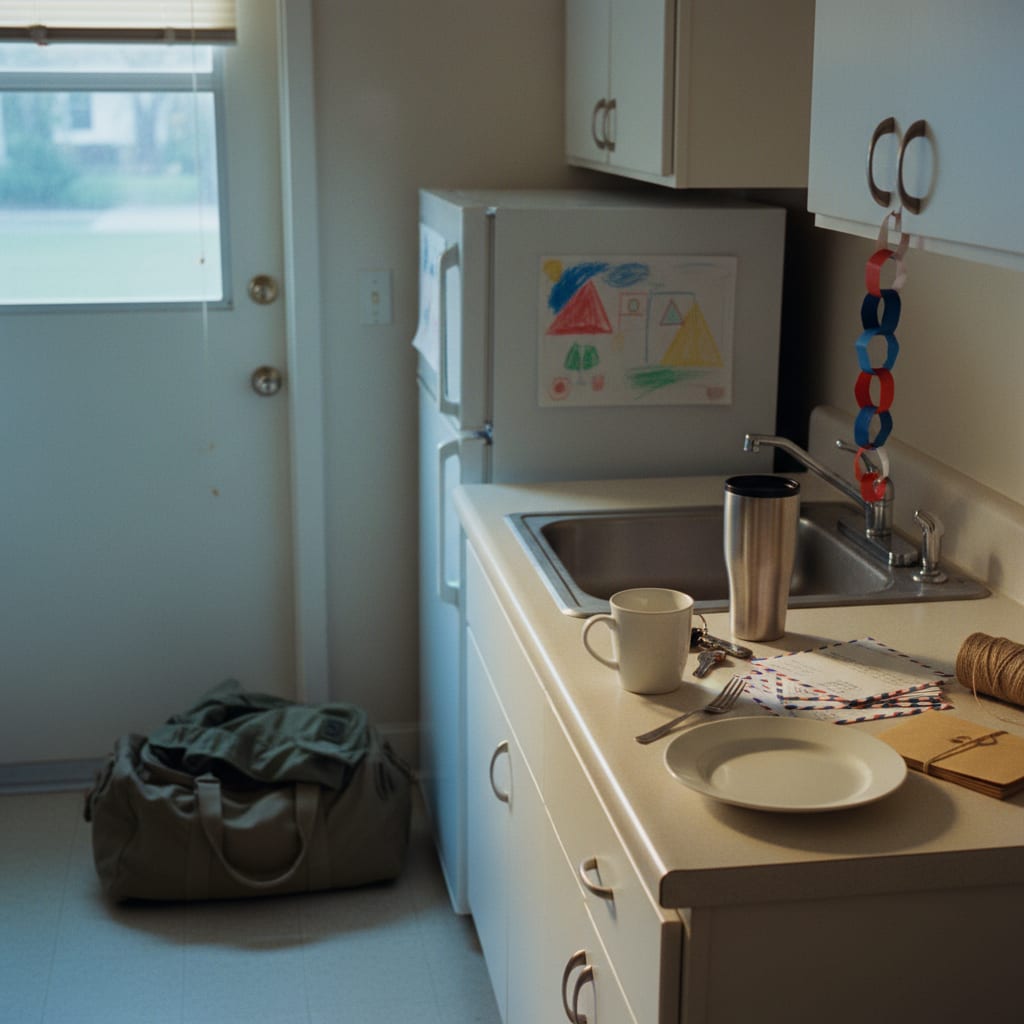
Geo-baching with small kids is a rhythm problem, not a distance problem. Unlike a deployment, you’re reachable, you come back regularly, and the household absorbs a departure and a homecoming every few weeks instead of once. That repetition is the challenge: kids re-grieve each goodbye, the parent at home never gets a stable staffing level, and you arrive every visit into a house that has moved on slightly without you. The fix is a predictable pattern, a deliberate re-entry protocol every trip, and an honest accounting of the load on the parent who stays.
Why it isn’t a short deployment
About half the deployment playbook fits.
What carries over: the fixed bedtime sequence, the absent parent having an owned slot in the routine, rituals that don’t depend on somebody being available. What doesn’t carry over is the mental frame. A deployment has a shape — goodbye, middle, homecoming — and everyone braces accordingly. Geo-baching has no shape. It’s a low-grade, indefinite absence punctuated by weekends that are half reunion and half chores.
Two consequences. The household never fully converts to single-parent operations: the parent at home carries a solo load without the permission — or the support — a declared deployment brings. And the kids do the goodbye repeatedly — a four-year-old who cries at the door on Sunday night isn’t being dramatic, she’s doing the same piece of emotional work she did three weeks ago, from the top.
Whether an assignment allows the family to move at all is set by your orders and the tour type — that’s a conversation with your detailer, monitor or assignment manager and the transportation office, not something to take from a forum. Military OneSource is the useful front door for the family-side questions.
Pick the pattern, then publish it
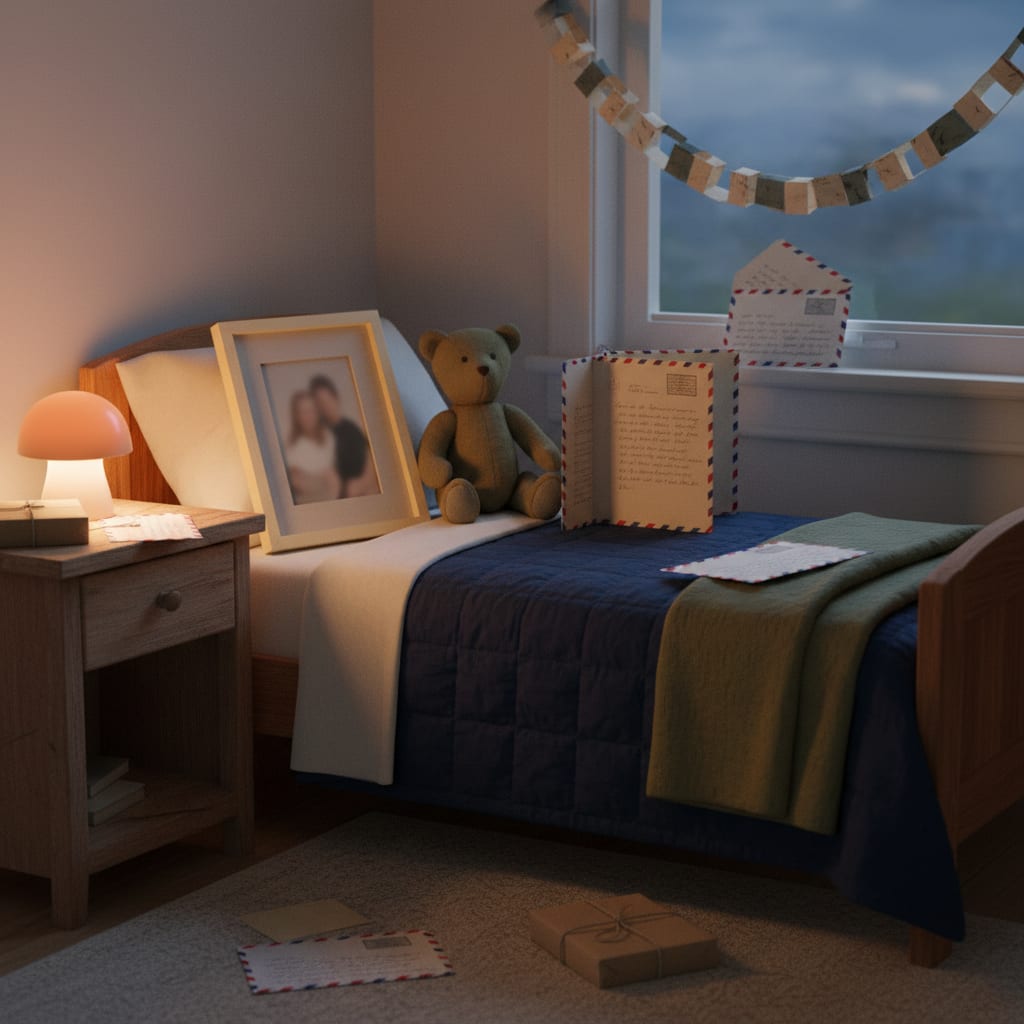
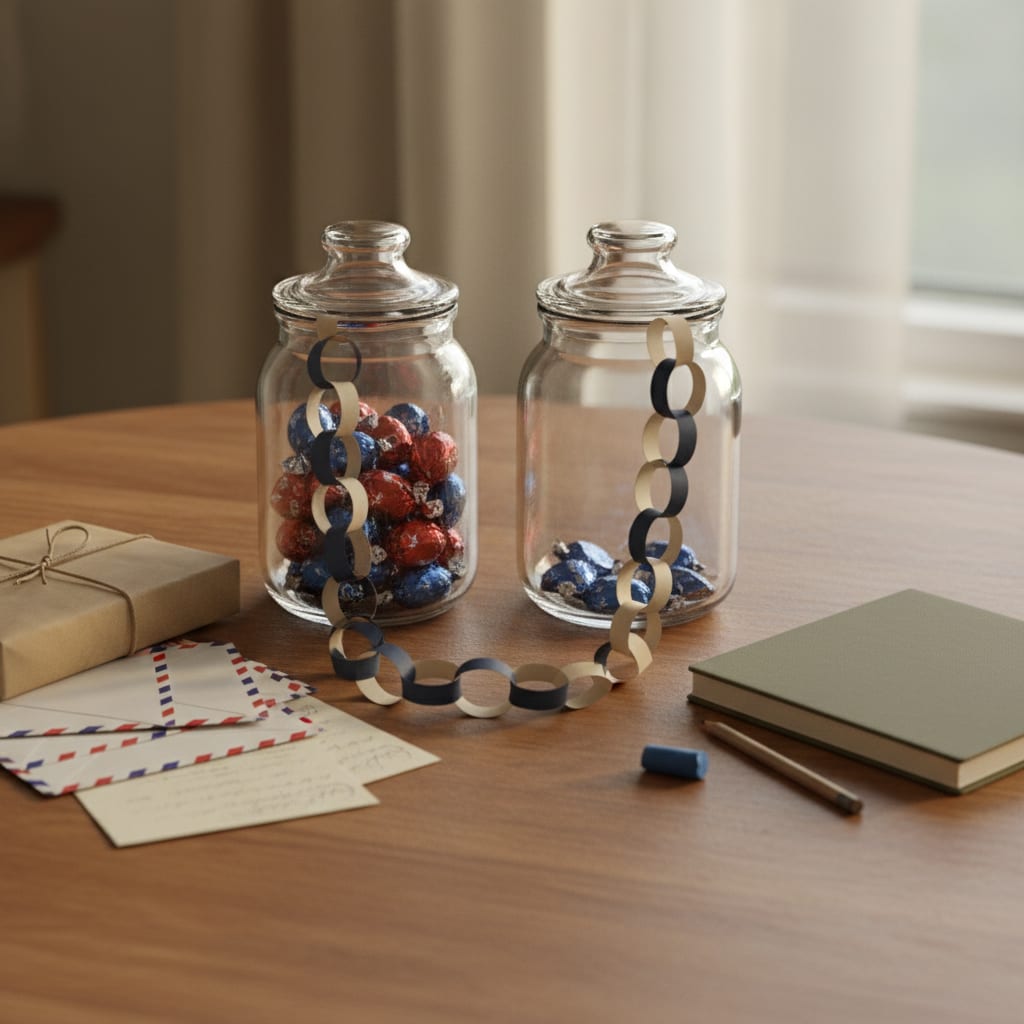
Whatever the pattern is — home every weekend, every other weekend, one week a month — name it, write it somewhere the kids can see, and defend it. A paper chain that reads four sleeps until Dad does more for a preschooler than any conversation about the assignment: kids under five can’t hold an abstract schedule, but they can count objects.
Keep the between-visit contact on a rhythm too, built out of things you control. Not “we’ll call when I can” but a fixed slot: the same twenty minutes at bath time on the same evenings, plus a recorded story that plays every night whether or not you’re on the line. The full set of rituals — recorded voice, video messages, the shared object, the out-tray of drawings — works the same here as across an ocean, and is in keeping kids connected to a deployed parent.
One geo-specific addition: the daily small thing. Because you’re reachable most days, a two-minute call at a fixed time beats a long call once a week. Small and daily reads as present; long and occasional reads as an event, and events are what you’re trying to stop being.
Run a re-entry protocol every single time
You arrive Friday night, keen to be Dad, and walk into a system that’s run without you for three weeks. Within an hour you’ve overruled a rule, corrected a bedtime, and been told by your spouse — accurately — that you don’t live here anymore.
Treat every arrival as a small handover, the way a longer absence gets treated in reintegration after deployment:
- Receive before you take. Ask what changed — bedtime, food rules, who is allowed what. Two minutes in the driveway saves the weekend.
- Follow their sequence on night one. You get to hold the book. You don’t get to redesign the routine.
- Don’t be the holiday. If every visit is presents, pancakes and no bedtime, you’re a treat and the other parent is the administration. Do a boring shift on purpose: the school run, the bath, the 6 a.m. wake-up while your spouse sleeps.
- Leave the same way every time. A short fixed goodbye at the same point in the day. Long, sad, drawn-out Sunday departures teach kids to dread Sunday. Say the line, do the thing, go.
Expect a wobble for a day or two after each departure; it shortens over months. If it’s getting worse instead, look at the goodbye ritual first; it’s usually the variable.
Bedtime, from four hundred miles away
Bedtime is where the absence lands. Two rules keep your place in it.
Your slot doesn’t move. A recorded story, a goodnight line, a song — same point in the sequence, every night, whether you called or not. If it’s conditional on your schedule, it will fail on a Tuesday and the kid will experience your absence twice.
You don’t run bedtime by phone. Tempting — you’re right there on a screen, the kid is stalling, the parent at home is fraying. But a live parent on video at lights-out extends bedtime rather than ending it, and hands the parent in the room a second thing to manage. Do your slot earlier, get off, and let the operator on site fly the approach. The nightly sequence, run single-handed, is in solo parent bedtime during deployment.
Protect the parent who stays
The load on the at-home parent is heavier than it looks from the other end. No unit sends a casserole for a geo-bach. Practical, unromantic things that help:
- Buy back time, not stuff. Cleaning, laundry service, an extra day of childcare, a sitter on a fixed weeknight. A grand gesture on Saturday is worth less than three hours alone on a Wednesday.
- Fix childcare before the assignment starts. Waitlists are long, and a solo parent with no backup is one sick kid away from a crisis at work.
- Build a local bench. Neighbours, other spouses, family who can be called at 6 a.m. The case for doing this early is in the military extended family.
- Take the mental load off remotely. School paperwork, insurance calls, birthday presents — all doable from anywhere. Do them.
- Watch for the drift. Couples who geo-bach for years often describe waking up as roommates who share a calendar. A weekly adults-only conversation, no logistics in the first ten minutes, is a cheap counterweight.
When to reconsider the arrangement
Geo-baching is a reasonable answer to a hard question — a spouse’s career, a kid’s school, an ageing parent, a housing market. It’s also a decision worth re-examining rather than defaulting into.
Signals worth taking seriously: the at-home parent’s health going sideways, a kid whose behaviour or sleep is deteriorating over months rather than settling, a marriage running on logistics alone, or an arrangement meant to last one tour quietly becoming the shape of your family. None of those mean stop. They mean the decision deserves a real conversation, ideally with a counselor who has seen a hundred of these — non-medical counseling is one of the better-hidden benefits of military life.
FAQ: geo-bachelor life with young kids
What does geo-bachelor mean?
It describes a service member stationed away from where their family lives — sometimes because the tour doesn’t allow dependents, sometimes because the family chose to stay put for a job, a school, a house or family support. Practically, it means running two households and commuting between them.
How do you explain geo-baching to a toddler?
In objects and counts, not concepts. “Dad works far away and comes back after four sleeps” plus something they can physically count down beats any explanation of assignments. Say it the same way every time — consistency of wording matters more than completeness at this age.
Is geo-baching harder on kids than a deployment?
Different rather than harder. Deployment has a defined shape and mobilises support; geo-baching is lower-intensity but repeats the goodbye indefinitely, often with no formal support at all. Kids usually adapt to the rhythm within a few months, and the departures stay the sharp edge.
How do I stay a real parent from another state?
Own jobs, not moments. Take a standing responsibility that spans the whole gap — bedtime slot, bills, school communication — and do a boring shift every time you’re home. Kids measure presence by reliability, not by how good the weekends are.
How often should a geo-bachelor come home?
Whatever cadence you can genuinely sustain, held consistently. A predictable every-third-weekend is easier on a small child than an unpredictable most-weekends, because the pattern is what they lean on. Publish it, protect it, and don’t promise a visit you might cancel.