Keeping Kids Connected to a Deployed Parent
The rituals that keep kids connected to a deployed parent are the ones that don’t require the deployed parent to be available. Build the connection out of things you control at home — a recorded story at bedtime, a photo the kid can carry, a running box of drawings, a weekly video message recorded whenever there’s signal — and treat live calls as a bonus rather than the backbone. Kids need the absent parent to feel present and reliable, and reliability is the part a satellite link can’t promise. Everything below is built on that principle.
Build for no bandwidth, not for good bandwidth
The most common connection plan is “we’ll video call every night.” Right instinct, wrong architecture. Comms availability varies enormously by mission, location and time zone, and the rules about what can be shared are set by the unit — none of it negotiable from your kitchen. Build a ritual on top of a nightly call and the ritual fails on exactly the nights it’s needed, and a small kid experiences the failure as a second, sharper absence.
So invert it: anything on a schedule the kid can count on must be producible without the deployed parent being reachable. Anything requiring them live is a bonus, announced only once it’s actually happening.
The recorded voice does the heaviest lifting
Before the goodbye, record everything you can. This is the highest-value hour a deploying parent will spend, and it’s routinely skipped because it feels sentimental in a week that’s already full.
Record, at minimum:
- Three or four bedtime stories, read at normal pace, including the kid’s current favourite. A recordable storybook puts the voice inside a physical book the kid controls — a toddler who can open the book herself is not waiting for an adult to grant access to her parent.
- A goodnight message, twenty seconds, in the deployed parent’s own words, to be played at the same point in the routine every night.
- Songs. Whatever gets sung in your house. Badly is fine; badly is better, actually, because it’s recognisably them.
- A few answers to predictable questions, for the three-and-up crowd: where I am is a place I can’t say, I’m safe, I’m coming home, I love you.
Keep backups in more than one place. A phone that dies with the only copy of the bedtime story is a genuinely bad night.
The recording gets a fixed slot in the sequence — same point, every night — as covered in solo parent bedtime during deployment.
Live calls: shorter, earlier, lower stakes
When calls do happen, a few things make them land better:
Put them earlier in the evening. A call at lights-out is a stimulant, and a dropped connection at 7:45 leaves you re-running bedtime on a distraught child.
Keep them short. Little kids have about ten good minutes of screen conversation in them, less if they’re tired. Ending while it’s going well beats stretching it until someone wanders off and the deployed parent watches a ceiling.
Give the call a job. Free-form “how was your day” collapses fast with a four-year-old. Give it a task: read one page each, show-and-tell one object, play a guessing game, tour the fort in the living room. Structure carries the kids who freeze on camera.
Let them leave. A kid who wanders off mid-call isn’t rejecting anyone. Let the deployed parent talk to the adult for the rest of the slot.
Never promise the next one. “We’ll call again soon” is honest. “We’ll call Thursday” writes a cheque a mission signs.
Asynchronous connection, which is most of it
Between calls, the connection is carried by things that move slowly. That’s a feature — slow things are countable, physical, and available at 4 p.m. on a Tuesday when a kid suddenly needs their parent.
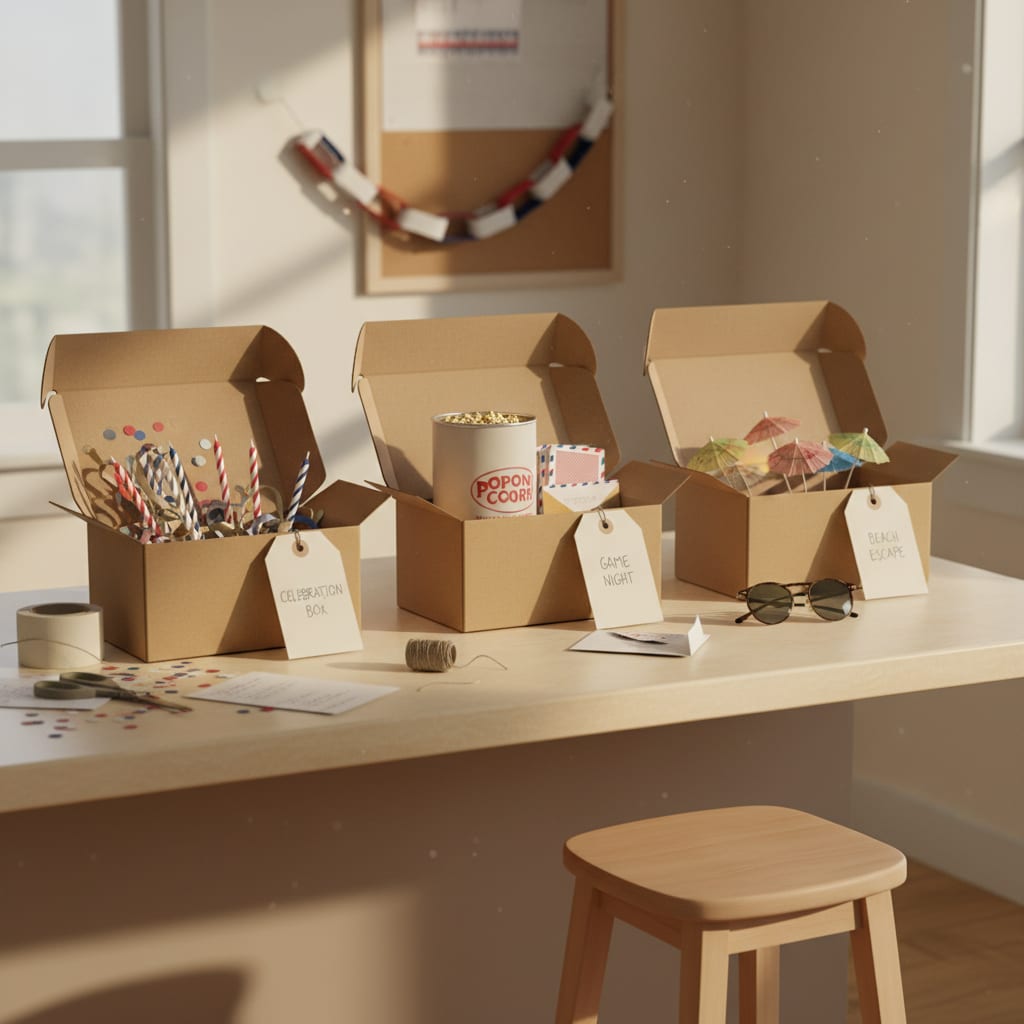
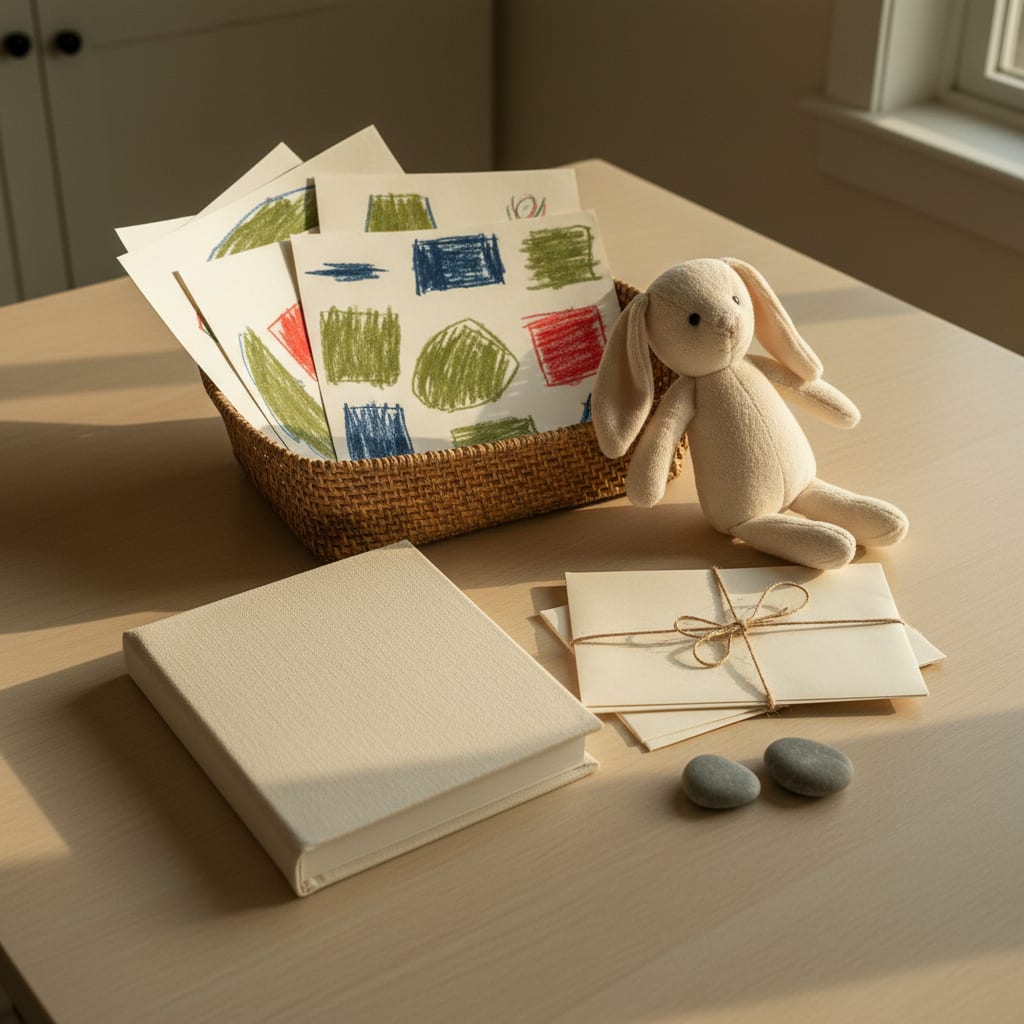
- The out-tray. A basket where kids put drawings, school work and dictated notes as they make them. When it’s full it becomes a package. Kids get to do something about missing someone, which is the whole point; the packing side is in military care package ideas.
- Video messages both ways. A ninety-second clip from the kid recorded at bath time, sent whenever there’s signal, and one back whenever there’s a window. No schedule, no expectations.
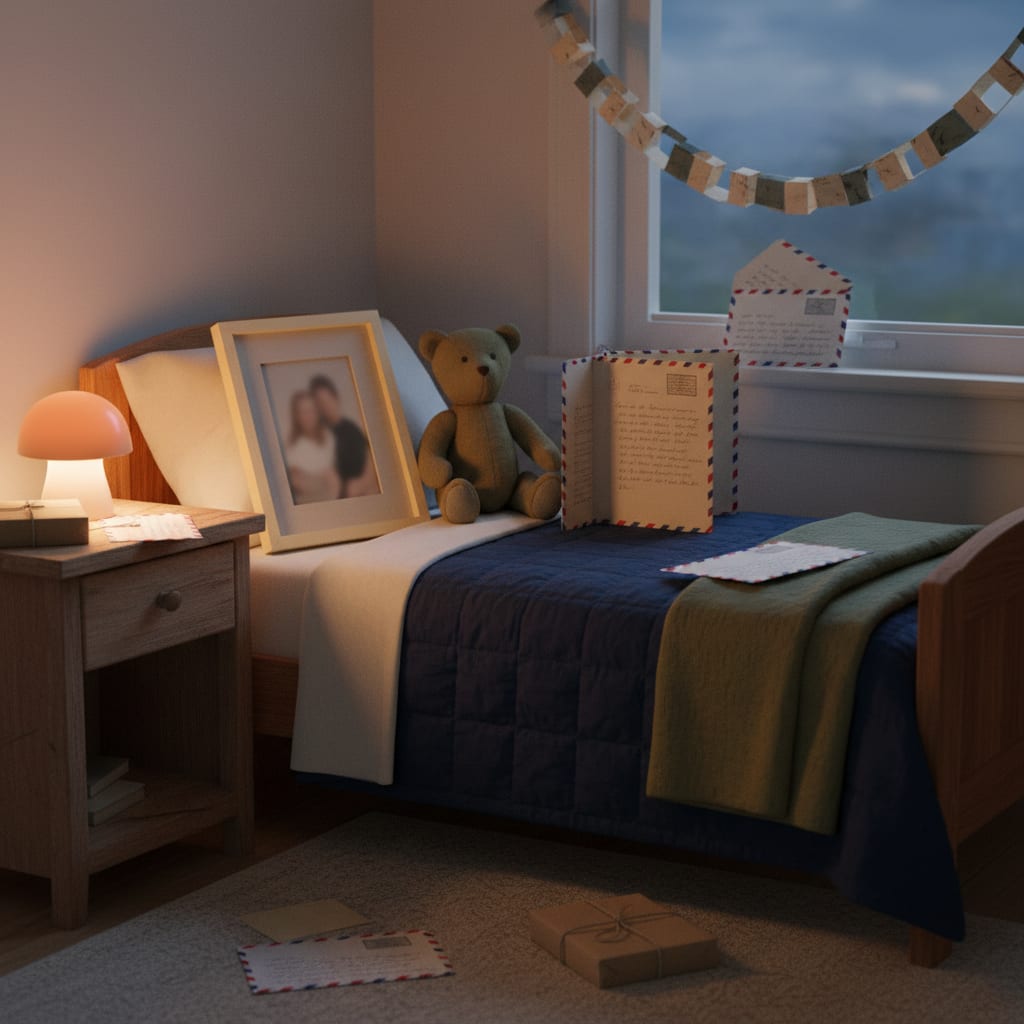
- The open-when letters. Written before departure, opened on defined triggers — a bad day, a lost tooth, the halfway mark. Templates and prompts are in deployment letters to kids.
- A shared object. Two of the same small thing, one in each place: a keychain, a smooth stone, a bracelet. Younger kids in particular do better with something they can hold than with anything on a screen.
- The same book on both ends. Two copies, one chapter a week. It gives older kids something to talk about on a call that isn’t a status report on their feelings.
One caution: keep locations, dates and movements off social media and out of the kids’ classroom projects. Follow your unit’s guidance on what can be shared and when.
Age by age
Under two. Voice and photographs, repeatedly, with zero expectation of a reaction. Recognition is maintained by repetition, not intensity.
Two to four. Physical and ritual: the shared object, the countdown they can touch, the recorded book they can open themselves. Video calls are hit and miss at this age, and a bad one means nothing.
Five to eight. Now they can participate: dictating letters, recording messages, marking the countdown, choosing what goes in the box. A kid with a job in the connection plan feels less powerless.
Nine and up. Direct contact where possible — their own messages, their own chapter of the shared book, a call time not shared with siblings. Also privacy: older kids sometimes want to say things that aren’t for the whole living room.
The traps
Turning connection into a chore. If the drawing basket becomes a nightly requirement, it stops being a relationship and starts being homework. Available, not mandatory.
Making the kid manage the adult’s feelings. “Daddy’s so sad without you, tell him you miss him” puts a load on a five-year-old that belongs to the grown-ups.
Over-scheduling the ceremony. Some families run themselves ragged on rituals — the calls, the countdown, the box, the letters — until the deployment is all the household talks about. Ordinary life is load-bearing too: a family movie night that’s genuinely fun does more than a fourth countdown craft.
Assuming silence means fine. The quiet kid who never asks about the deployed parent is often holding the most. Keep the door open with low-pressure invitations rather than interrogation.
FAQ: staying connected during a deployment
How often should a deployed parent talk to their kids?
As often as the mission allows, with the household built so that nothing depends on it. For young children, a reliable recorded ritual every night beats an unpredictable live call, and the two together are better than either alone. Frequency matters less than predictability.
What if my child won’t talk on video calls?
Completely normal, especially between about two and five. Give the call a task instead of a conversation, keep it short, and let them leave when they’re done. Forcing participation teaches them that calls are unpleasant, which is the one outcome worth avoiding.
How do you keep a baby connected to a deployed parent?
Repetition, not intensity. Play their recorded voice daily, keep photographs at the baby’s eye level, and use their name out loud in normal conversation. Babies won’t show you it’s working, and it still is — recognition comes back much faster in babies who heard the voice all along.
What if the deployed parent misses a call they promised?
Don’t promise. If it’s already happened, keep the explanation short and blameless — “the call didn’t get through tonight, we’ll hear from him when we can” — and go straight to a ritual you control, like the recorded story. Kids handle the absence of a call much better than they handle a broken commitment.
Are countdowns a good idea for young kids?
For toddlers, a countdown to a distant date usually creates anxiety rather than comfort — they have no working sense of a month. Countdowns work better started in the last stretch, made from something concrete they can watch shrink, and with the end date treated as approximate. Return dates move, and a kid counting to a specific day takes that hard.