Reintegration After Deployment: A Dad's First 30 Days
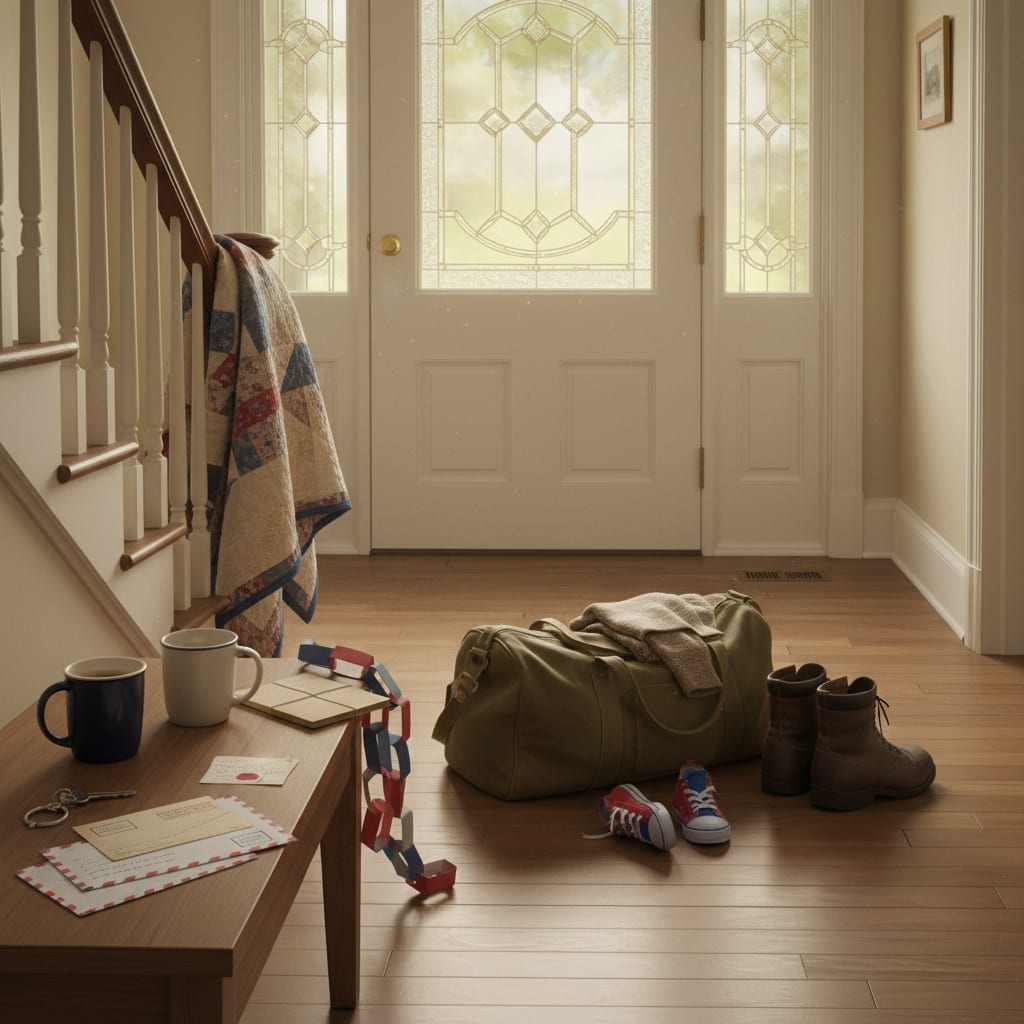
Reintegration after deployment works best when you treat it as a slow, deliberate handover rather than a return to the way things were. The house ran without you; the routines changed, the kids changed, and the parent who stayed home built a system that works. For the first week, be a guest on purpose — observe, follow their sequence, take nothing back. Over weeks two to four, take back one job at a time, with the other parent’s agreement, in the order the household actually needs. Expect kids to be strange, expect the euphoria to fade around week three, and plan for both.
It’s a handover problem before it’s a feelings problem
Everybody arrives braced for the emotional part. What blindsides most returning parents is the operational part: you don’t know where anything lives anymore. The dishes moved. Bedtime is twenty minutes earlier. The four-year-old has a script you’ve never heard, written by a parent who worked out, alone, that it stops the crying.
That’s not a problem to fix. It’s a system built under load by someone who had no relief, and it works. The most common reintegration mistake is walking in and improving it — reorganizing the kitchen, moving bedtime back, overruling a rule you weren’t there for. Each of those reads to your spouse as the months you carried this alone didn’t count. Run it like any handover: receive before you take. You’d never take the watch by rearranging the console.
Week one: receive the brief
Keep it small. Sleep. Eat. Be present without being in charge.
- Ask before you do. “Do you want me to do bath, or watch how you do bath?” Both answers are fine. Asking is the whole move.
- Follow their sequence exactly. Same order, same words, same lights-out. You’re learning the current version of your own household, not auditing it.
- Don’t reorganize anything. Not the pantry, not the garage, not the calendar. Give it a month.
- Don’t fix the discipline. A returning parent who arrives with a stricter regime becomes the villain in a story that was going fine.
- Say the quiet part. “You built this and it works” is worth more than every gift in your duffel. Say it out loud, in front of the kids.
Push the big social stuff back a week too. Extended family will want the homecoming immediately; a week of just your household first is sequencing, not rudeness. If people are already inbound, the guest room and hosting plan is worth setting up before you land rather than after.
Weeks two to four: take back one job at a time
After the first week, start the handover for real — one job at a time, with an actual conversation about which one.
Good early jobs are bounded and repeatable: the school run, bath night, Saturday breakfast, bedtime for one kid. Bad early jobs carry institutional memory — medical appointments, finances, school communication — because those come with context you don’t have and produce a week of “where is the…” questions.
Two rules. A job you take is a job you own, including the part where the other parent stops checking; half-transferred jobs are worse than untransferred ones. And take them at the pace the other parent sets, not the pace your guilt sets — returning dads who take everything back in a weekend to prove they’re useful land as relief rather than reinforcement.
If you were the one who stayed home for a stretch and you’re now handing the house back, the reverse problem is in the temporary stay-at-home dad tour — letting go of a system you built is harder than it sounds.
What the kids will actually do
None of this is misbehaviour. It’s normal, and knowing it’s coming takes most of the sting out.
- Babies and young toddlers may not recognize you, may cry when handed over, and may want only the parent who stayed. Hardest to take personally, fastest to resolve — usually days to a couple of weeks of low-pressure presence.
- Two to four brings clinginess to the other parent, testing of you, regression in things they’d mastered, and sometimes flat rejection: I want Mommy to do it. Don’t take the bait. Stay steady and do the boring shifts.
- Five and up can look fine for a fortnight and then get angry, usually once they’re sure you’re staying. Let the feeling exist; hold the behaviour standard.
Expect sleep to be the loudest signal. Kids process transitions after dark, and the bedtime routine is the place where the change of personnel gets negotiated. That has its own run-book: rejoining a bedtime routine that changed while you were gone.
The part nobody briefs: week three
The first two weeks are usually good. Around week three the reunion glow burns off and the ordinary grievances come back — chores, money, whose turn it is, the fact that you’re two adults in a house that had adapted to one.
That dip is so common it should be printed on the manifest. It doesn’t mean reintegration failed; it means the performance ended and real life resumed. Name it in advance, both of you, so it arrives as a milestone rather than evidence. What helps: a standing weekly conversation with no kids in it, one protected solo hour a week each, and a moratorium on major decisions — houses, jobs, cars, dogs — for the first month.
Where to get help, and when
The reintegration support that exists is genuinely useful and consistently under-used: non-medical counseling, chaplains, unit and family-readiness programs, and the reintegration events tied to your return. Programs, eligibility and timelines vary by branch and component, so start at Military OneSource and your unit’s family-support contact rather than assuming what’s available.
Go early rather than at the point of crisis. Signs it’s time: anger that frightens you or the kids, sleep that won’t come back, drinking that’s doing a job, a child whose regression is deepening rather than easing after a month, or a marriage conversation that has stopped happening. None of that is a character verdict. It’s a normal load on a system that just did something hard.
Sleep is usually the last thing to settle
Even when everything else lands, the kids’ sleep lags the reunion by weeks — later bedtimes, night waking, a toddler who suddenly needs someone in the room. Some of that is emotional and passes with steadiness. Some of it is that the schedule drifted: naps got dropped, bedtimes moved, and nobody had the bandwidth to recalculate.
If you can’t tell which one you’re in, that’s the part worth handing to a plan rather than a hunch. Betteroo’s personalized sleep plan asks about your kid’s age, temperament and current schedule and builds the day’s nap-and-bedtime timing around them, adjusting as things change. It runs around $20 a month. Honest limits: it plans the schedule, not the reunion — it won’t tell your five-year-old why he’s angry, and toddlers retain veto authority. What it removes is the guessing, at a point when both adults have very little guessing left in them.

FAQ: reintegration after deployment
How long does reintegration after deployment take?
Most families describe a month to feel functional and several months to feel normal, and it isn’t linear — a good first fortnight is often followed by a harder third week. Kids’ sleep settles last. If things are still deteriorating after a couple of months, that’s the signal to bring in unit or Military OneSource support.
Why is my child rejecting me after deployment?
Because they’re protecting themselves and testing whether you’re staying. Rejection, clinginess and anger are standard, and strongest between about two and five. The counter-move is unglamorous: be present for the boring shifts, don’t demand affection, don’t compete with the other parent, and let them come to you.
Should I change the household routines when I get back?
Not in the first month. The routines that ran while you were gone are load-bearing for both your spouse and your kids. Learn them, run them, and only then propose changes — jointly, once you’ve earned the context.
Do Reserve and Guard families get reintegration support too?
Yes, though the shape of it differs and varies by branch and component — which matters when you go straight from the airport back to a civilian job with no installation around you. Ask your unit’s family-support contact what applies to your return, and use Military OneSource as the general-purpose front door.