Deployment Letters to Kids: Open-When Letters That Land
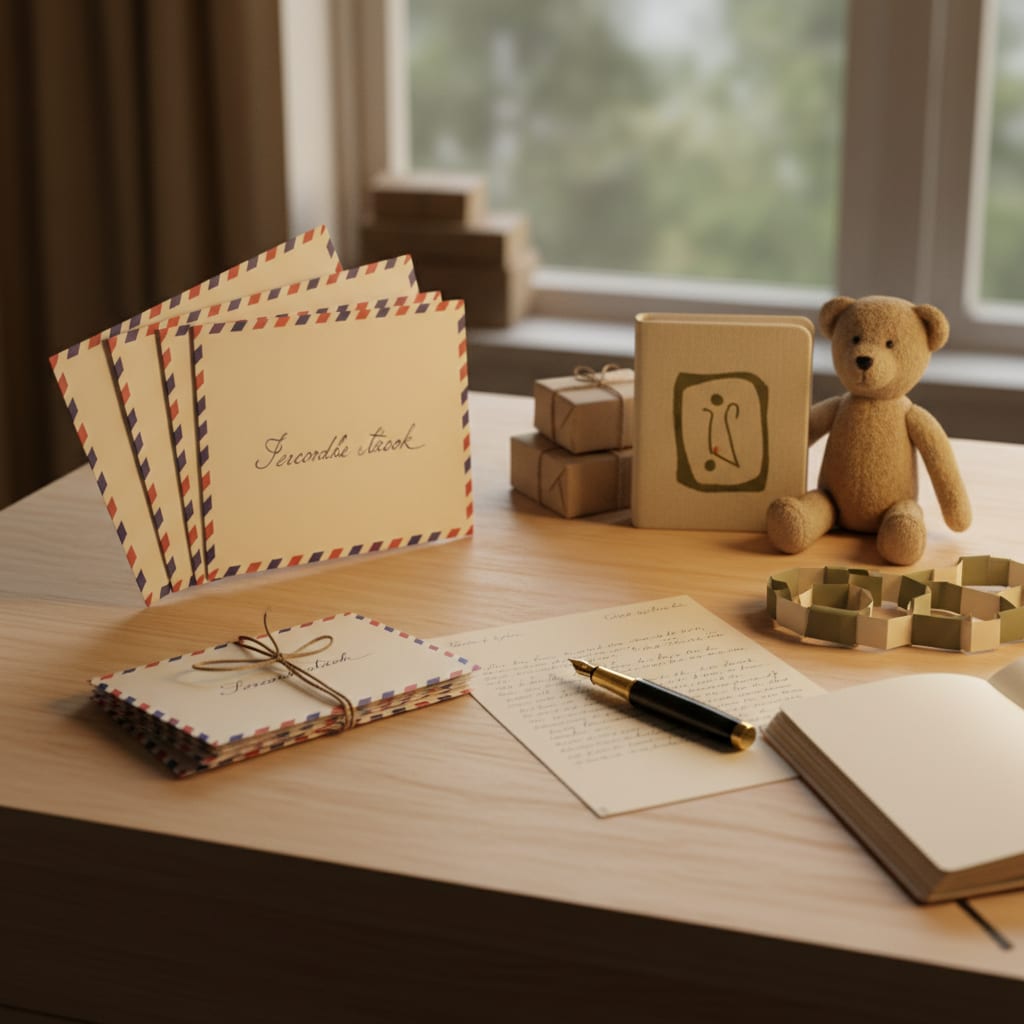
Deployment letters to kids work best as a small system written BEFORE the goodbye: a stack of “open when” letters for predictable moments (open when you miss me, open on your birthday, open when you’re mad at Mom), a few milestone letters for big days you might miss, and ongoing mail from downrange to keep the stream alive. Keep each letter short, concrete, and in your actual voice — a paragraph a six-year-old can hear at bedtime beats a page of ceremony. Here’s how to write the stack, what goes in each envelope, and the mistakes that turn a sweet idea into homework.
Why letters outrank almost everything
Calls are wonderful and unreliable — communication windows depend on the mission, and no dad should promise a schedule he doesn’t control. Letters are the opposite: slow, but permanent and re-readable. A five-year-old will ask for the same letter forty times, exactly like a favorite book, and every reading is the deployed parent walking back into the room. Letters also survive the deployment; the calls evaporate, the shoebox of envelopes becomes a family document. In the architecture of the whole deployment cycle, letters are the load-bearing connection channel precisely because they’re the one nobody can cancel.
The open-when stack
Write these before you leave, label them, and hand the stack to the at-home parent as ammunition for hard moments. A dozen covers most deployments:
- Open when you miss me. The workhorse — write two or three copies because it gets deployed often. One memory, one “here’s what I do when I miss YOU,” one job (“go check on Mom and make her laugh”).
- Open when you’re mad at Mom/Dad. Comic gold and quietly important: back up the at-home parent’s authority while validating the feeling. “She’s the boss. I checked. Also I love you.”
- Open on your birthday. Written like you’re there: what you’d do together, what you’re proud of, one prediction about the year ahead to laugh about at homecoming.
- Open on the first day of school. Short, brave, specific: “New backpacks smell like adventure. Find the kid who’s alone at recess.”
- Open when you can’t sleep. A calm-voice letter for the hardest hour — bedtime is where deployments pinch most, which is why the solo bedtime run-book and this envelope work as a team.
- Open when something great happens. So your celebration is pre-positioned. “I’m doing my proud dance right now. You can’t prove otherwise.”
- Open when the countdown feels too long. Pairs with whatever countdown ritual you’re running: “Look how much chain is already gone. We eat this whale one bite at a time.”
- Wildcard envelopes. Lost tooth, big game, bad day, “open for no reason.” Blank-labeled spares let the at-home parent improvise.
Milestone letters and the audio layer
For genuinely big days you might miss — a birthday, a first day of kindergarten, a holiday — write a fuller letter and mail a matching small package so the day has physical weight (the care package system handles the logistics side). Then add the audio layer: record yourself reading a few favorite picture books before you leave, plus short voice notes the at-home parent can play at bedtime. Recordable storybooks are the classic hardware, but a phone full of voice memos works fine. Audio catches what paper can’t — the specific way you read the villain’s voice — and toddlers too young for letters will wear out a recording.
Writing letters they’ll actually love
Write like you talk, at kid altitude. Concrete beats profound: “I saw a lizard the size of my boot” outruns “distance cannot diminish my love” with every child ever tested. One feeling, one memory, one question, one job per letter — the question (“what should we name the lizard?”) gives them a reason to write back, and dictated-to-a-parent replies count fully. Keep sad honest but brief: “I miss you at breakfast” is true and bearable; a page of longing is a weight a kid shouldn’t carry. And date everything — future-you will thank present-you when the shoebox becomes an archive.
Mistakes to skip
Don’t promise dates or call times you don’t control; anchor to events instead. Don’t write the perfect-father version of yourself — kids smell ceremony, and the letter that lands is the one that sounds like you at the dinner table. Don’t guilt (“be good so Mom doesn’t have a hard time” curdles fast). And don’t let the project’s size stop you: three honest open-when letters beat zero perfect ones, and you can mail the rest from downrange one envelope at a time.
FAQ: deployment letters to kids
What do you write in an open-when letter for a child?
Keep it to four moves: one specific shared memory, one feeling named plainly, one question to answer back, and one small job. A paragraph or two is plenty — you’re writing a hug, not an essay.
How many open-when letters should you write before deployment?
About a dozen covers the predictable moments — miss-me (write multiples), birthday, first day of school, can’t-sleep, mad-at-the-at-home-parent, something-great, plus a few blank wildcards. More is fine; three is infinitely better than none.
What about kids too young to read?
Address the letters to the at-home parent to read aloud, and lean on audio: recorded storybooks and short voice memos. For babies, the letter is really for later — write it anyway and date it; it becomes a keepsake that grows into its reader.
Should the at-home parent read the letters first?
A quick skim is reasonable quality control — you’re the one deploying each envelope at the right moment, and you’ll want to know which letter promises what. Agree on this before the goodbye so nobody feels surveilled.