Recordable Storybooks for Deployment: Which to Buy
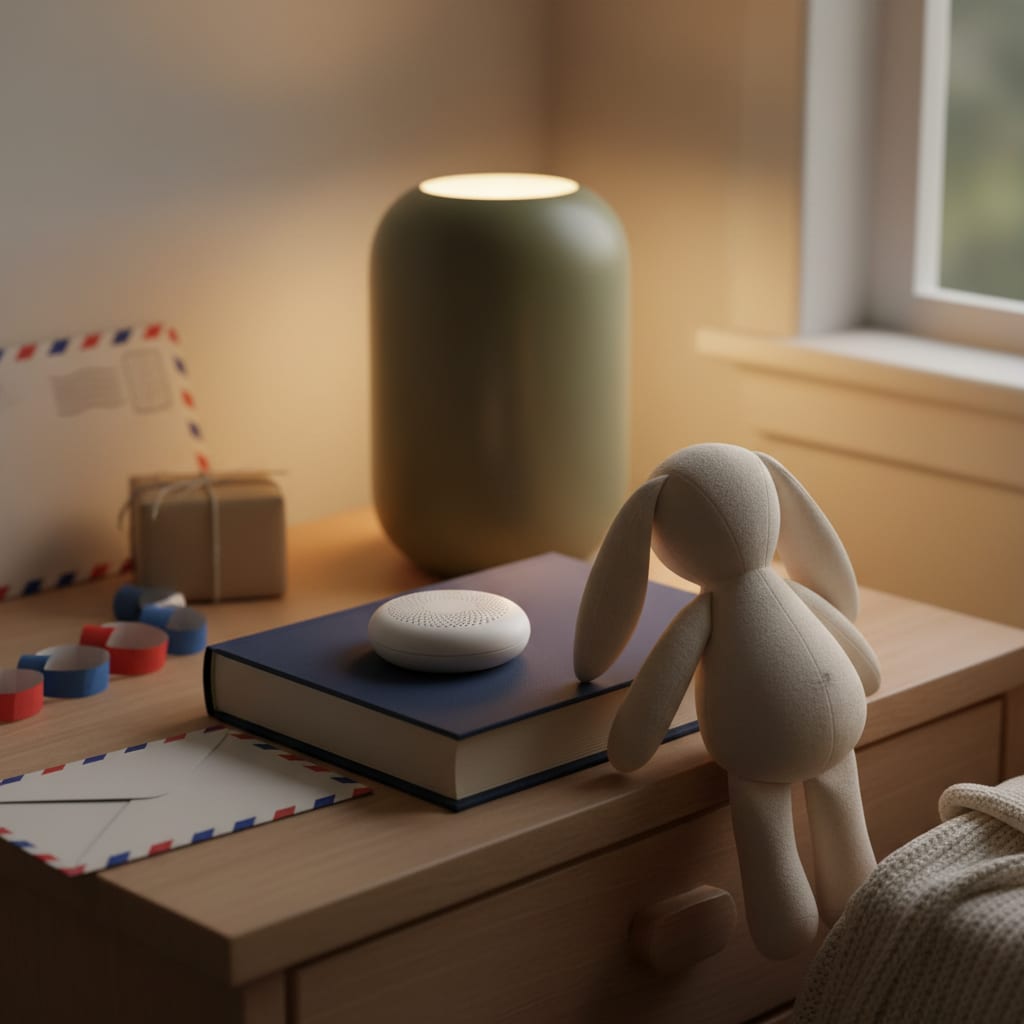
A recordable storybook lets a deploying parent read a book once, in their own voice, and leave it behind for a kid to play as often as they like. There are four ways to get one: a purpose-built Hallmark book, a title from the Record a Story series, a clip-on recorder that converts a book you already own, or a voice module sewn into a toy. Buy the pre-made book if you want it done in an evening; buy the clip-on recorder if the book that matters is one already on the shelf. Then record it properly, because a bad recording gets played twice.
What you’re actually choosing between
The mechanism is the same in every case — a small speaker, a button, and flash memory that survives the batteries coming out. What differs is how much of the book is recordable, how long the total recording can be, and whether you’re locked into a title someone else wrote.
That last point is the real decision. A pre-made recordable book has a story printed in it, and that story is usually about missing someone. Some kids love that. Some kids do not want to be told, nightly, that they miss their dad — they want the dinosaur book, in his voice. Know which kid you have before you spend anything.
Hallmark’s recordable storybooks
Hallmark makes the largest range, and it’s the easiest option: pick a title, press record on each page as you read it, hand it over. The pages hold your voice permanently, so the batteries dying doesn’t wipe the recording.
Two titles map onto a deployment almost too neatly. Under the Same Moon is built around the idea of two people apart under one sky, which is a concept small children take to immediately. All the Ways That I Love You is less situation-specific and ages better, which matters if the book is going to be in rotation for a year.
The limitation is per-page recording time. These are short picture books, and each page gives you a handful of seconds — enough to read what’s printed plus a couple of words of your own, not enough to improvise. Practise the page before you press record.
The Record a Story series
The Record a Story books work the same way and were explicitly aimed at families separated by distance and by work. Guess How Much I Miss You is the on-the-nose deployment pick; I Love You So Much is the version for a kid who’d rather not have the absence named out loud every night.
Compared with Hallmark’s line the range is smaller and the production is plainer. On the other hand, they’re often cheaper, and for a book that is going to be chewed, dropped and eventually left in a car, plainer is not a defect.
Clip-on recorders turn any book into a recordable one
This is the option most families don’t know exists, and it’s frequently the best one. A clip-on storybook recorder is a small device with a long total recording time that attaches to a book you already own — so the recordable book becomes the book your kid already asks for every night, read by the parent who is leaving.
For a fuller version, the Recordable Book Buddy provides a bank of buttons so each page gets its own recording and a kid can turn pages at their own pace, the way a real read-aloud works. It’s more device to manage and more to explain to a three-year-old, and for the right kid it’s much closer to the real thing than a five-second page.
The strongest argument for this route: continuity. The book doesn’t become a deployment artefact that gets put away on homecoming day. It stays the bedtime book.
Voice modules for a doll or a bear
If the object your kid actually carries is a stuffed animal rather than a book, put the voice in the animal. A 30-second voice recorder module sews into a seam and gives a toy a button that says one thing.
Thirty seconds sounds short. It isn’t — it’s roughly two sentences said slowly, which is exactly the right length for something that will be pressed hundreds of times. This is also the upgrade that turns a photo doll into a talking one, covered in the daddy doll guide.
Recording it so a kid will actually play it
The recording is worth more care than the purchase.
- Record in a quiet room, close to the device, at normal volume. Every one of these has a cheap microphone. Shouting distorts; whispering vanishes.
- Use the kid’s name. It’s the difference between a story and a message.
- Don’t say goodbye. A recording that ends on a farewell turns bedtime into the airport. End the way you’d end a normal night.
- Read at reading speed, not radio speed. Slower than feels natural on a first take.
- Do the whole book in one sitting so the voice, the room noise and the energy match from page to page.
- Re-record until it’s right, then hand it to the kid before the goodbye. You want to see whether they like it while there’s still time to make another one.
Batteries, and the failure nobody plans for
The recording lives in memory and survives a battery change — but the battery compartment is usually behind a small screw, and finding a screwdriver at bedtime in month four is a bad experience for everyone in the house.
Do three things on day one: note the battery size, buy a pack and tape it inside the book’s back cover, and find the screwdriver now. Then make a copy of the recording on a phone, because glue fails, buttons fail, and a book that has been loved for eight months eventually stops working. That backup is a two-minute job and it saves a genuinely rough evening later — the kind that can knock a whole routine sideways, which is its own problem covered in deployment sleep problems.
FAQ: recordable books for deployment
How long can you record on a recordable storybook?
Pre-made picture books typically give you a few seconds per page across ten to twenty pages. Clip-on recorders offer much more — often ten minutes or more in total — which is why they suit longer books. Check the listing for the specific model, since the range is wide.
Do recordable books lose the recording when the batteries die?
The mainstream ones don’t; the recording is stored in memory that survives a battery change. Keep spare batteries taped inside the cover anyway, and keep a phone recording of the same reading as insurance against the hardware itself failing.
What’s the best recordable book for a deployment?
If you want a story that names the situation, a title built around distance works well for younger kids. If your child would rather not be reminded nightly, use a clip-on recorder on the book they already love. The second option is the one families tend to be happiest with a year later.
At what age do recordable books stop working?
Around five or six, most kids move from the book to a video message or a voice note they can play themselves. The voice-module-in-a-toy version lasts a bit longer because it isn’t obviously a baby product. Older kids do better with letters and shared journals.
Can the parent at home record one too?
Yes, and it’s worth doing for the other direction — a kid can send a recorded book, or a page of one, to a deployed parent. It’s flat, light and posts easily, which makes it a good addition to the care package rotation.