Deployment Journals and Countdown Kits Worth Buying
A deployment journal and a countdown kit look like the same purchase and they are not. The journal is a place to put feelings and it works best when it’s guided, dated loosely, and belongs to the kid alone. The countdown is a machine for making time visible, and the only rule that matters is that it must survive the return date moving. Buy one of each, buy them cheap, and expect the homemade versions to get used more than the boxed ones.
Two different jobs, two different products
Parents tend to buy these together and then wonder why one gets used daily and the other is abandoned by week three. Usually the jobs got mixed up.
A journal absorbs. It’s for the bad afternoon, the thing the kid didn’t want to say at dinner, the drawing of the dog. Nothing about it should be tied to a schedule, because the day a child needs it is not a day you can plan.
A counter measures. Its value is that it’s physical, visible from the doorway, and moves once a day so a small person can see progress they can’t otherwise perceive. It should never absorb feelings and never carry a promise. Buying one product to do both — a journal with a countdown printed in the corner of every page — produces something that fails at both.
Journals for kids: guided beats blank
Give a six-year-old a blank notebook and a hard year and you’ll get three pages. Guided journals work because the prompt does the starting for them, which is the hardest part.
Deployment Journal for Kids is the long-standing one here, built around a parent being away rather than adapted from a general feelings journal — the prompts assume the situation instead of dancing around it. For younger kids who write slowly or not at all, While You Were Gone pairs wide-ruled lines with bordered drawing space on each page, the right ratio for roughly five to eight. A four-year-old will draw and dictate; write what they say verbatim, including the parts that sting.
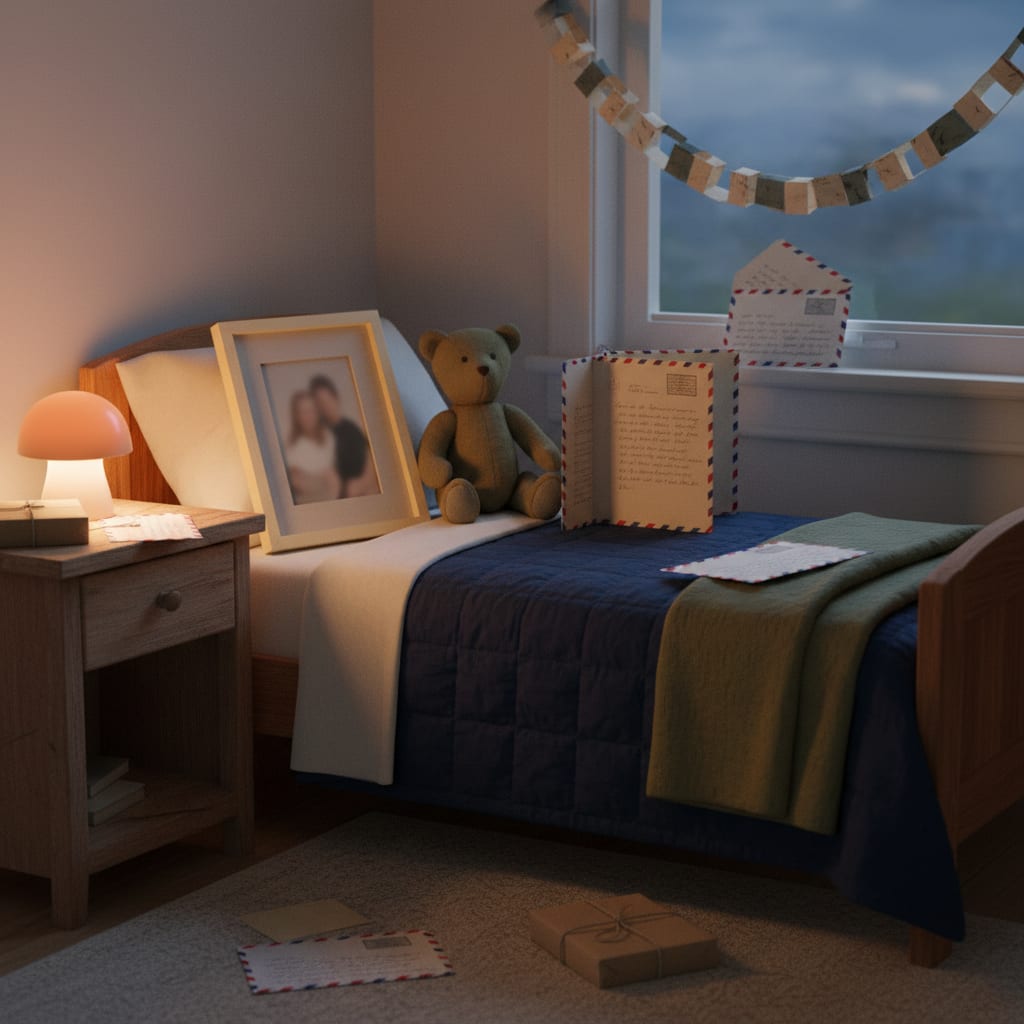
Two things separate a used journal from a shelf ornament. It has to be genuinely private — if a child suspects it will be read out loud on a video call, the honest entries stop immediately. And it needs a home: on the nightstand, in reach, not in a drawer with the good stationery.
The book that travels back and forth
A different and often better format: one journal, mailed in both directions, with each person answering the other.
Between Dad and Me is the best-known version — prompts on each spread, room for drawing, and a structure that means neither person has to invent something to say. The deployed parent answers a few pages and mails it home, the kid answers and mails it back, and it becomes the artifact from that year both of them keep.
The obvious risk is the mail. A pass-back-and-forth book can be in transit for weeks and can be lost outright, which is a real loss rather than an inconvenience. Photograph the filled pages before each leg, and don’t make it the only channel — it works best riding along with the gifts and post you’re already sending rather than being the whole correspondence.
The adult version — a journal kept by the person deployed, like this service member’s deployment journal — is a separate purchase, and plenty of people do it in a plain notebook instead.
Countdown kits: what to buy when
Boxed countdown kits are mostly craft supplies with a theme printed on them. That’s not an insult — the supplies are the useful part — but buy on mechanism rather than on packaging.
For an absence measured in months, a wooden countdown box with changeable number windows counts up to three digits and, crucially, can be reset. Nothing else here handles an extension so gracefully: you change the number and the object keeps working.
For a countdown a kid can build, paper chains are still the best value in the category. A pack of pre-cut chain strips that lock without glue or tape removes the part where a four-year-old and a glue stick ruin the table, and the traditional gummed lick-and-stick strips do the same job for less. One loop per week for anything long — a daily loop over a long absence produces a chain that will not fit in the house.
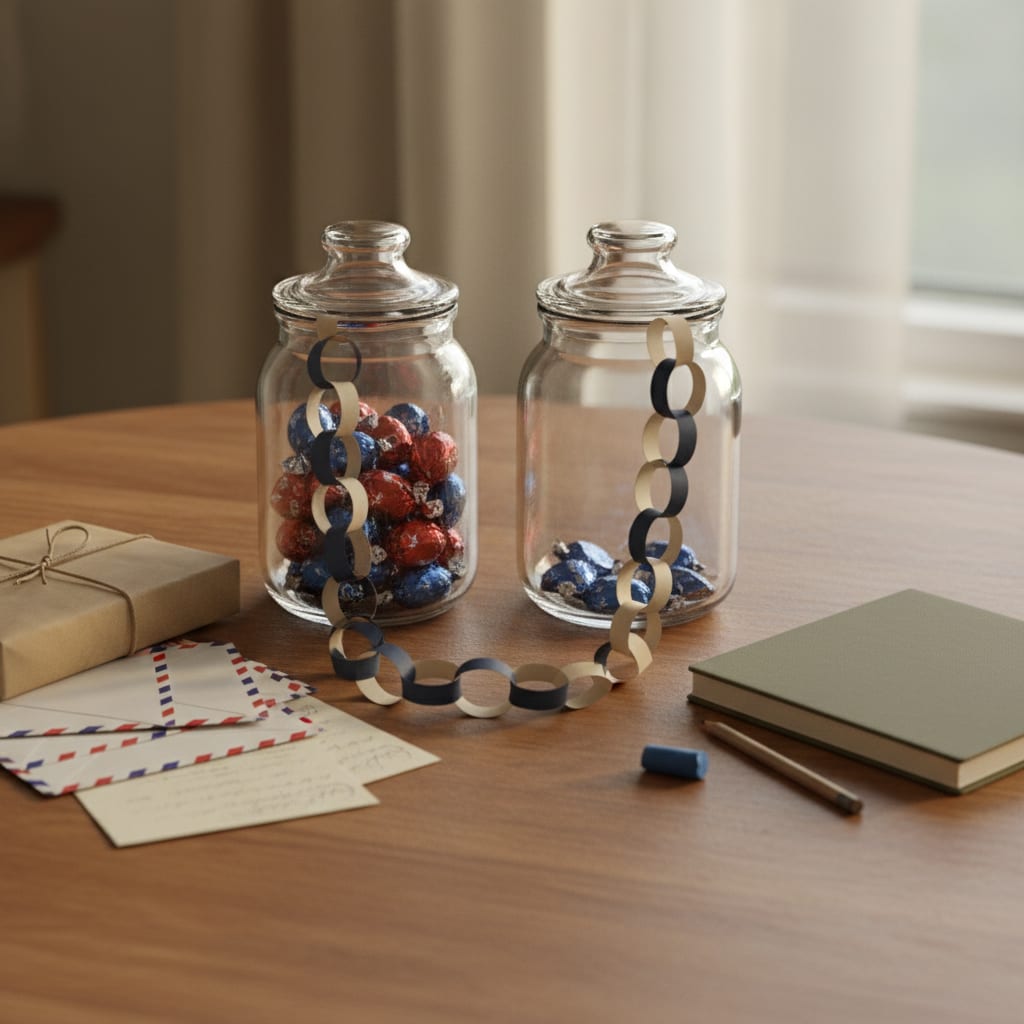
For something a small child can eat, the kiss jar. A bulk bag of foil-wrapped chocolates and two jars: one full, one empty, one chocolate moved every night. The full jar shrinking is the clearest picture of elapsed time a three-year-old will ever get.
Avoid boxed sets with a fixed number of pre-printed days. They’re the same failure as a dated banner: they cannot absorb a change, and a countdown running out while the parent is still gone is genuinely rough.
The kiss jar, honestly assessed
It gets recommended everywhere, so be straight about the drawbacks. It’s a nightly sugar hit at bedtime. It doesn’t scale — six months is a lot of chocolate, and by month four the jar is a landscape feature nobody looks at. And a sibling raid on it is a plausible, surprisingly upsetting event.
The fixes are easy. Use marbles, pom-poms or beads, with chocolate reserved for weeks rather than days. Use a jar sized for a month and refill it, which turns one distant finish line into twelve short ones. Or split it: marbles on weeknights, a wrapped sweet on Fridays. The mechanism is what matters — something visibly leaving one container and arriving in another — and the contents are negotiable.
Making your own for almost nothing
Almost every boxed kit has a free version, and in this house the free ones have lasted longer: a jar of dried beans, a strip of masking tape down a doorframe, a stack of index cards on a ring. The homemade advantage is repair — when the timeline changes, you add loops or beans without anybody feeling like the plan broke. The wider set of variations, including the ones that hold up when a date slips, is in deployment countdown ideas.
What tends to go wrong
- The countdown promises a date. Build it around a range — “sometime around the end of summer” — not a day. Most common mistake, worst payoff.
- The journal gets read aloud. Once, and it’s over. Privacy is the entire mechanism.
- Both objects live in the kid’s room and go invisible. Move the counter somewhere with traffic; let the journal stay private.
- Nobody moves the counter for a week. Attach it to the last step of bedtime or it will drift.
- The kit replaces the letters. It doesn’t. Objects mark time; words carry the relationship, which is what the open-when letter stack is for.
FAQ: deployment journals and countdown kits
What is the best deployment journal for a child?
A guided one written for this situation, with drawing space as well as lines. Blank notebooks get abandoned because starting is the hard part. Match format to age: drawing space under about seven, more writing room above it.
How do you make a deployment countdown that survives a date change?
Use a counter you can add to: a resettable number box, a chain you can extend, a jar you refill monthly — anything that changes the total without an announcement. Fixed-length kits with pre-printed days fail, because a countdown reaching zero with nobody home is a bad afternoon.
Should a deployment journal be private?
Yes, and say so out loud at the start. A child who suspects their entries will be read on a video call will write only safe things. If something in it needs sharing, ask them first — the asking is the part that keeps the journal usable.
Are boxed deployment countdown kits worth the money?
Usually not much more than the supplies inside them. Buy the mechanism — chain strips, a number box, jars and something to move between them — and let the kid decorate it. Homemade gets more use because it can be repaired when the timeline shifts.
What age is a countdown kit right for?
Roughly two or three at the low end, when a child can move an object and notice a pile shrinking, up to about eight, when a calendar does the job instead. Older kids prefer counting toward events — a birthday, a term ending — over counting days.