Bedtime After a PCS: A Week-by-Week Sleep Reset
Bedtime after a move comes back in stages, and the order is the whole trick. Week one, rebuild the room — dark, sound, the same bedding — and accept whatever bedtime you can get. Week two, restore the exact sequence you used at the old house, in the same order, at roughly the old time. Week three, fix the clock: time-zone shift, nap timing, wake windows. Week four, expect a test and hold the line. Most kids under five settle within two to four weeks in the new house, and the ones who don’t are usually being asked to do all four weeks at once.
Week one: rebuild the room, not the routine
The first week is a construction job, not a parenting one. Your kid’s bedroom was the most familiar environment they had, and a move deletes it — the light is different, the sound is different, the door is on the wrong side.
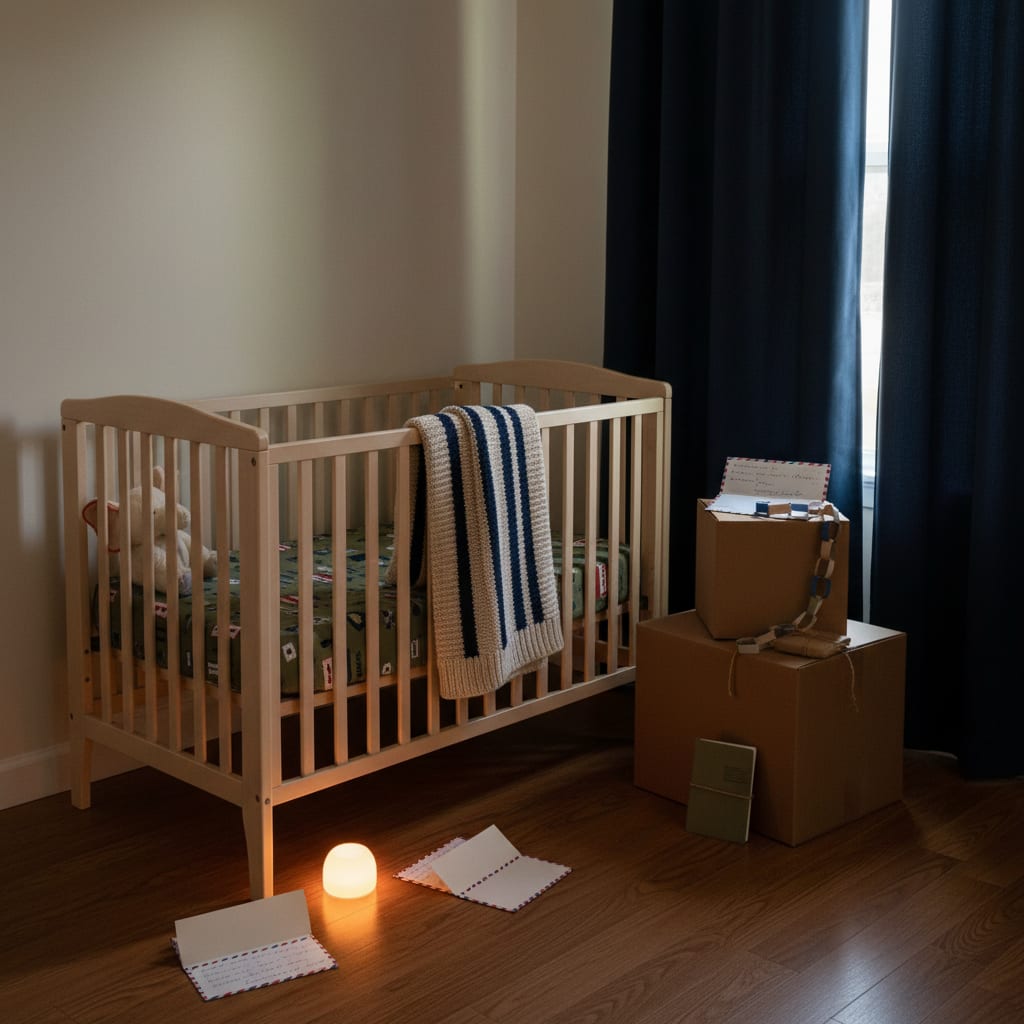
Put the sleep space up first, before the kitchen, before the TV, before anything that isn’t a bed for the adults: the actual crib or bed, the same sheet and the same lovey, unwashed if you can stand it, and the sound machine in roughly the same position relative to the bed.
Darkness does more work than any other single variable, and new houses leak light in places the old one didn’t — a streetlight where there wasn’t one, a hallway with no door, a bedroom facing the wrong way for a summer sunrise. A portable blackout curtain panel with suction cups fixes it in an afternoon without drilling anything you’d have to explain at the final inspection, and it packs for the next move. For what actually blocks light versus what merely dims it, Betteroo’s rundown of what makes a room dark enough for a baby is worth ten minutes before you buy anything permanent.
Expect this week to be ugly: late bedtimes, extra contact, an adult sitting in a dark room longer than they’d like. That’s not the routine failing, it’s the routine suspended while the room gets built. The triage for the move itself is in PCS with a baby.
Week two: put the sequence back exactly
Now restore the run-book — and restore it precisely, because kids track order far more accurately than they track time.
Same steps, same order, same words: bath, pajamas, two books, song, lights, the same line at the door. If the old house had a specific staircase moment or a particular chair, do the closest available version in the new house and do it identically every night. It matters less that the chair is the same chair than that there is a chair, in the same slot in the sequence.
Two things to resist this week. Don’t improve the routine because you have a new house and a fresh start — a new bed, dropped naps, a moved bedtime and a big-kid room in one fortnight is four changes stacked on one nervous system. And don’t extend bedtime to compensate for the day’s chaos; a longer bedtime doesn’t reassure a tired kid, it gives them more time to notice that everything is different.
The one legitimate addition is a short new-house tour inside the sequence — walk the hallway, look in the closet, note that your bedroom is there. Two minutes, every night, until it’s boring. Boring is the objective.
Week three: fix the clock
By now the room is right and the sequence is back, and the remaining problems are usually arithmetic rather than emotion.
- Time zones. A move across zones means the internal clock is running on the old duty station. Shift in increments — fifteen to thirty minutes every couple of days — using morning light and mealtimes rather than trying to negotiate the last hour at bedtime.
- Nap drift. Travel weeks wreck naps: car naps at the wrong hour, a nap skipped for a house viewing, a late one that pushed bedtime out. Rebuild the day from the wake-up time, not from bedtime backwards.
- Wake windows that moved. Kids grow during moves. If bedtime is being fought hard, the gap between the last nap and lights-out may simply be wrong now — too long makes an overtired kid look defiant, too short makes one who isn’t tired and is happy to discuss it at length.
- Bedtime creep. Late bedtimes from week one become the new normal if nobody walks them back. Move it earlier by ten to fifteen minutes every few nights.
If your toddler has also gone from crib to bed as part of the move, expect a longer road and read PCS with a toddler — the two changes interact badly and are worth separating by a few weeks where you can.
Week four: expect the test
Around the third or fourth week, when the house is finally functioning, a lot of kids fall apart. Parents read it as a setback; it’s usually the opposite.
The first weeks run on adrenaline and novelty. Once the place stops being new, everything deferred arrives — the old room, the friend down the street, the fact that this is permanent. It shows at bedtime because bedtime is when small people process things.
Hold the sequence exactly. Add reassurance inside the routine rather than by extending it: an extra minute of the same book, a fixed check-back at a stated interval, a photo of the old house on the shelf if they ask for one. What you’re demonstrating is that the routine is now the thing that doesn’t change, which is precisely the reassurance a moved kid is looking for. The wider settling-in picture — school, childcare, finding your people — runs on a similar clock and is in your first 30 days at a new duty station.
When it isn’t the move at all
Sometimes the timing is a coincidence. A sleep regression, a growth spurt, teeth or a nap transition doesn’t check your orders first, and a move gets blamed for a wobble that would have happened in the old house on the same weekend.
The tell is what responds. Move-related disruption improves as the room and the sequence stabilize; a developmental wobble doesn’t care how well you’ve unpacked, and usually arrives with other signs — new skills, appetite changes, naps failing in a pattern.
If you genuinely can’t tell which one you’re in — and in an unpacking month, with two adults running on four hours, most people can’t — that’s the part worth handing to a plan built around your actual kid instead of a hunch. Betteroo asks about your kid’s age, temperament and current schedule, builds the day’s nap-and-bedtime timing around them, and updates it as things change; it runs around $20 a month. Honest limits: it fixes the schedule, not the house — it won’t unpack your kitchen, and your toddler retains full veto authority. What it removes is the guessing, a fair thing to offload in the month you’re also learning where the grocery store is.

FAQ: bedtime after a house move
How long does it take a child to sleep normally after a move?
Commonly two to four weeks for children under five, assuming the room is rebuilt quickly and the routine goes back to what it was. Longer if the move stacked other changes on top — a new bed, a dropped nap, new childcare — or if bedtime drifted late and nobody walked it back.
Should we change bedtime after a PCS?
Not deliberately, and not at first. Restore the old bedtime in local time, shifting in fifteen-to-thirty-minute steps if you crossed time zones. Redesigning the schedule while a kid is already off balance turns one adjustment into two.
Should my kid sleep in our room for the first few nights?
It’s a reasonable bridge, and it’s easier to start than to stop. If you do it, name the end date out loud — “three nights, then your room” — and then hold it, because the exit is the hard part.
Why is my toddler suddenly worse three weeks after the move?
Because the novelty ran out and the loss arrived. It’s a normal, well-recognized delayed reaction rather than a sign the move damaged anything. Keep the routine identical, let the feelings exist, and expect it to fade over a couple of weeks.