Homecoming Bedtime: Rejoining a Routine That Changed
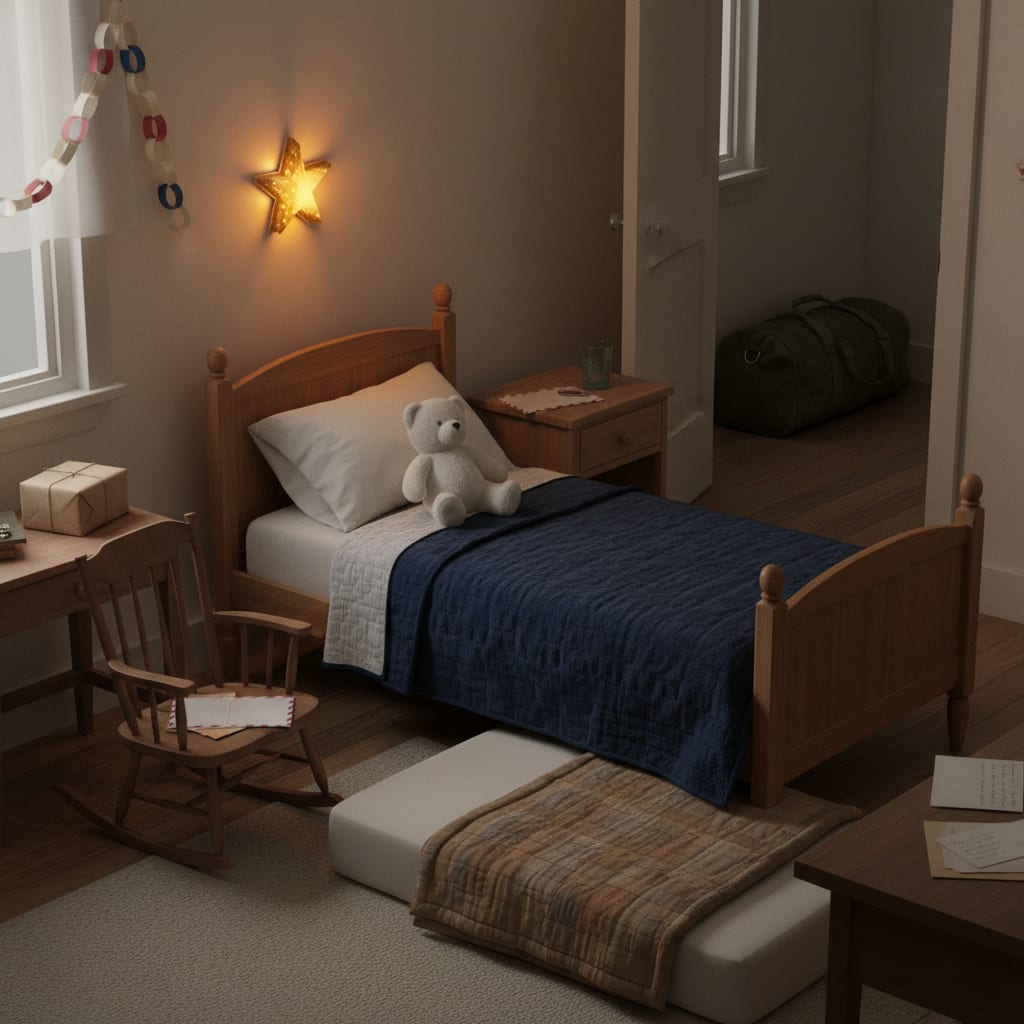
You come home and bedtime is unrecognizable. It’s earlier, or later, there are two extra songs, somebody sleeps on a mattress on the floor, and your kid wants the other parent for every step. The move is not to fix it. For the first week, watch and follow — learn the current sequence exactly as it runs. Then take one step, keep it identical to how the other parent does it, and add steps weekly until you’re running the whole thing. Rejoining a bedtime is a handover, and handovers go badly when the incoming operator starts by changing the checklist.
The routine you left isn’t the routine that’s running
Whoever held the fort rebuilt bedtime alone, under load, iterating until something stopped the crying. That version has been running for months, and your kid knows it word for word. So bedtime at 7:10 instead of 7:30, a lamp instead of the overhead light, a closing line you’ve never heard — that isn’t drift. It’s a system built by someone competent, tuned to a kid who is also no longer the kid you left.
Two things follow. Don’t change it in week one. And ask for the brief. Get the whole sequence written out in daylight — order, timings, exact words, what’s allowed and what got ruled out and why. The “why” matters most; half the things that look strange in a homecoming bedtime are the scar tissue of a bad month.
This is the bedtime-shaped slice of the wider handover in reintegration after deployment.
Week one: attend, don’t operate
For the first several nights, be in the room and off the controls.
- Go in with the other parent and let them run it exactly as they have been. You hold the water cup. You are cargo.
- Learn the words. The closing line, the song, the thing that gets said about the stuffed dog. Say them the same way when your turn comes.
- Don’t correct. Not the timing, not the number of books, not the light you’d have turned off. There’s no bedtime hill worth dying on in week one.
- Don’t audition. A returning parent who makes bedtime exciting has made bedtime longer, and the parent who has run it for six months will notice within ninety seconds.
- Take the boring adjacent jobs. Bath, teeth, pajamas, dishes downstairs. Useful, present, not disruptive — that’s the assignment.
If the deployment rituals are still in the routine — the recorded story, goodnight to the photo — leave them in. They fade once the kid stops needing them. Ripping them out on night two to prove you’re back reads to a four-year-old as a loss, not a gain.
Then take one step at a time
After roughly a week, start the transfer — a step at a time rather than a night at a time.
Take teeth and pajamas first: mechanical, low stakes, easy to run identically. Then the book, the first genuinely valued slot. Then the song or the closing line, the piece the kid is most attached to. Then lights-out and leaving the room — the hardest part, because that’s where the goodbye lives. Run each step exactly as the other parent runs it, for several nights, before adding another.
And when you take the whole thing, take it properly: the other parent leaves the room and stays gone. A half-handover where they hover in the doorway teaches the kid you’re on probation, which they will then test at length. Getting both parents able to run bedtime cold is its own project, worked through in dad-led bedtime.
”I want Mom to do it”
Decide the response in daylight, not at 7:45 with a crying kid and an audience. It isn’t a verdict on you: it’s a kid protecting the one arrangement that stayed stable while everything else moved, and testing whether you’re staying this time. Two to five is the peak zone, and it’s loudest in the kids who missed you most.
- Don’t take the bait. “I know, buddy. Mom’s downstairs and I’ve got you tonight” — flatly, warmly, once. Then continue the sequence.
- Don’t hand it back. If the other parent rescues, protest works, and tomorrow’s is louder. Agree this in advance; it’s much harder in the moment.
- Split the difference for a few nights if you must. They do the song, you do the book. Then swap. A staged handover beats a heroic one.
- Do the low-stakes shifts too. The Saturday nap, the 6 a.m. wake-up, the ordinary Tuesday. Kids re-attach through boring repetition, not big moments.
If the rejection deepens over months instead of easing, raise it with your pediatrician or with non-medical counseling through Military OneSource.
The schedule probably drifted, and that’s a different problem
Some of what looks like reunion turbulence is straightforwardly a schedule that moved while you were away and nobody had the bandwidth to recalculate. Over a six-month absence a toddler may well have dropped a nap or changed the shape of the day, and a bedtime built for the old nap structure produces an overtired kid fighting a routine that isn’t the problem. You’ll read that as “he’s struggling with me being back.” He’s struggling with accumulated overtiredness.
The tell is timing. Emotional turbulence clusters at the front of the night — stalling, requests, wanting the other parent. A schedule problem looks like a cooperative kid who still takes ages to fall asleep, or wakes at 5 a.m.
If you can’t tell which one you’re in — and in a reunion month, most people can’t — hand it to a plan instead of a hunch. Betteroo’s plan builder asks about your kid’s age, temperament and current schedule, produces the day’s nap-and-bedtime timing, and adapts as things change. It runs around $20 a month. Honest limits: it fixes the schedule, not the reunion, and your toddler retains veto authority — what it removes is the arguing about timings, which in the first month back is a real gift to a marriage.

Undoing the deployment workarounds
Most solo stretches leave behind an arrangement nobody would have chosen: a kid in the big bed, a parent on the floor until sleep comes, a 9 p.m. bedtime that grew ten minutes a month. These need to go eventually. Not this week.
Give the reunion a month to settle. Then unwind one thing at a time, slowly and visibly: a mattress that moves a foot further from the bed every few nights, a parent who sits by the door instead of on it, ten minutes clipped off bedtime a week. Announce it in daylight, and let the returning parent run the new version so the change and the reunion aren’t competing for the same evening.
Keep the homecoming itself separate from all of this. Banners, signs and the first-night celebration belong to the day — the welcome-home ideas are worth doing properly — and bedtime that same night should be as close to the standard sequence as you can manage. Big day, ordinary night — that contrast is the reassurance.
FAQ: bedtime after a homecoming
How long does it take a child to accept the returning parent at bedtime?
Commonly a couple of weeks to a couple of months, usually worse before better once the kid is sure you’re staying. Steady, boring presence shortens it. Pushing for affection, competing with the other parent, or handing bedtime back when they protest all lengthen it.
Should I change the bedtime routine now that I’m home?
Not for at least a month. The routine that ran during the deployment is load-bearing for your kid and it’s your spouse’s work. Learn it, run it identically, earn the operator seat — and then propose changes jointly, as changes rather than corrections.
Why is bedtime harder now than it was during the deployment?
Because the household changed again. Kids often hold together during the absence and come apart afterwards, once it’s safe to. Two adults also means two versions of the routine, and any inconsistency gives a tired kid something to negotiate.
Is my kid’s bad sleep about the reunion or about their age?
Check the schedule first. If nap timing, wake windows and bedtime are age-appropriate and the trouble sits at the front of the night with stalling and requests for the other parent, it’s the reunion. If they cooperate and still can’t fall asleep, or wake at 5 a.m., the schedule moved while you were gone and needs recalculating.