Bedtime When a Parent Is Away Two Weeks for Training
When one parent is away for a fixed fortnight — a course, a school, a training block — do not redesign bedtime. Hold the three or four steps the routine actually runs on, drop the optional ones, and plan the return nights before anyone leaves. Two weeks is the awkward length: long enough that a kid stops treating it as a blip, short enough that anything you build gets dismantled before it settles. The goal isn’t a new routine — it’s the same routine, running thinner, with a known end date.
A known length changes what you should do about it
Every other absence in this house’s vocabulary is open-ended or repeating. A deployment gets months of adaptation and deserves a purpose-built system; a weekly rotation needs its own shape because it never stops arriving. A fortnight is neither — a single bounded interruption with a date on the far end.
That date is the whole asset, and most households waste it. The instinct when a parent leaves is to do something: move bedtime, add a chart, let the four-year-old into the big bed “just while Dad’s away”. Each is a change the kid absorbs on the way in and again on the way out — three transitions where two would have done.
The American Academy of Pediatrics puts the general case plainly on the importance of family routines (loaded 2026-09-19): “Children do best when routines are regular, predictable and consistent.” Be rigid about the sequence, flexible about the load.
Work out what is load-bearing before the bag is packed
A few days out, split the evening into two lists — out loud, with both parents, because you will disagree about what goes where.
Load-bearing is anything the child uses to know where they are in the evening: the bath-or-not decision, the same two books in the same chair, one song, the same words at the door, lights out at the same time. Four items is normal.
Optional is everything accumulated since: the bath-toy negotiation, the stuffed-animal roll call, the drink of water that has become a fifteen-minute performance, the second story that only got added because two adults were free.
For two weeks the load-bearing list runs exactly as written and the optional list is quietly retired — not announced as a punishment, just gone, the way things go when a household is busier. Kids audit the sequence, not the inventory: they notice that books came after pyjamas, not that there were two instead of three.
One job people skip: check whether the routine secretly needs two adults. If it’s been running on parallel processing — one of you starting the bath while the other lays out pyjamas — it falls over on night one, for reasons unrelated to the absence. That is the one-adult duty-night audit at a fortnight’s scale.
Keep the away parent in the evening without building a machine
The temptation is to over-engineer presence: a nightly call, a countdown, a recording for every night, a sticker system. All of it is scaffolding you take down again in fourteen days. Pick one thing, at the same point in the sequence, every night.
- A recorded story slots into the book step you already have and needs nothing from the absent parent’s schedule. Record two or three before they go; a small child will hear the same one eleven nights running.
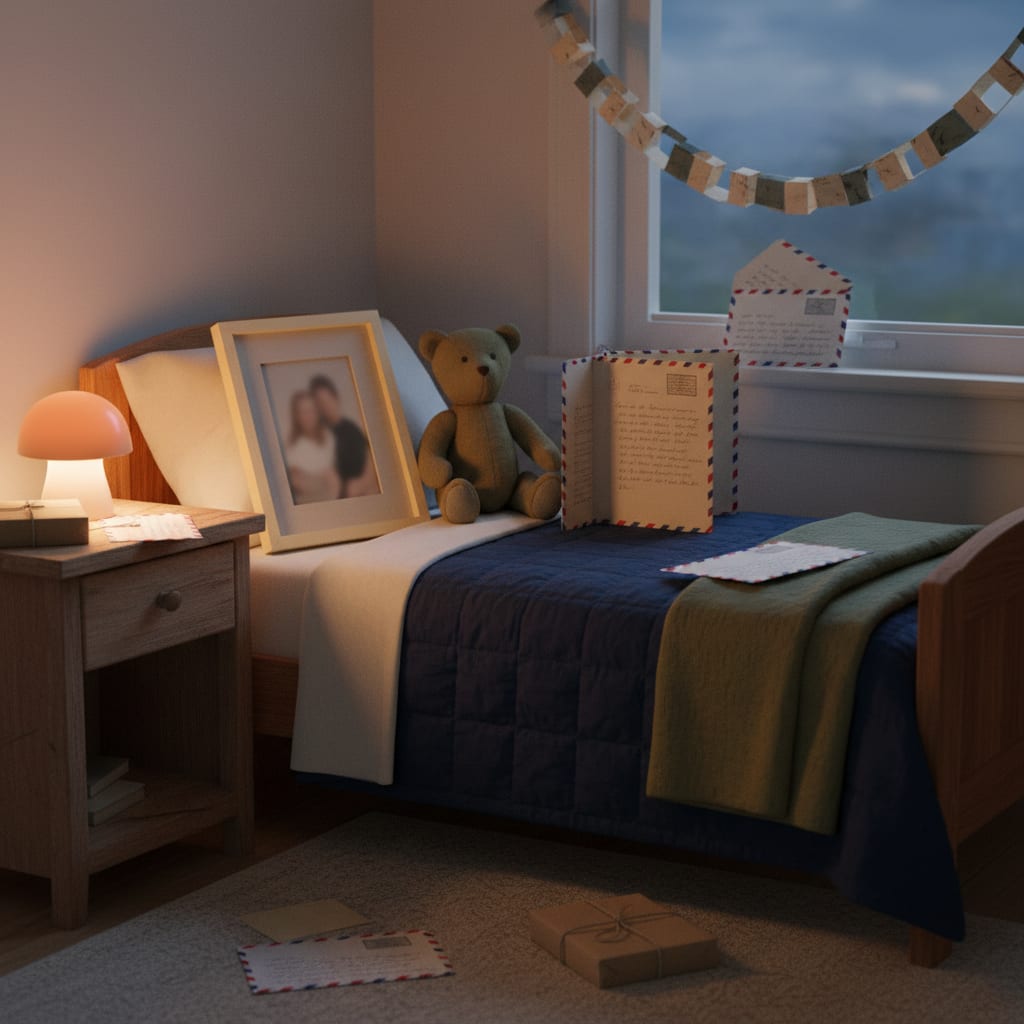
- One photo in one place — on the shelf by the bed, not migrating around the house — gives the kid somewhere to put the missing.
- A live call belongs before dinner, not at lights-out. A call at 7:40 p.m. winds a child up at the moment you need them winding down, and a dropped connection is a bad night you scheduled yourself.
Size it so that dropping it costs nothing. Some nights the call won’t happen; if the whole bedtime hangs off it, that night collapses.
Say the length once, in a unit they own — back on the Saturday with the market — then stop mentioning it, because a daily “only nine more!” re-opens the absence every morning. Promise a day, never an hour: courses run late, and a child told “Thursday night” who gets Friday morning has learned something about promises.
The first two nights, and the sag around day six
Nights one and two are usually loud. The absence is new, the routine is thinner, and the child is checking whether anything else has moved. Hold the times. The common mistake is letting lights-out drift because the evening is going badly, which teaches a fast lesson: when a parent leaves, the rules move.
Nights three to five are often fine, sometimes suspiciously so — that’s the novelty of being brave, which is real and temporary, not the problem being solved.
Around day six or seven, expect a sag. The novelty has run out, the far date still feels far, and the parent running the house has spent a week doing everything in series. This is where the optional-list discipline pays: spend the spare capacity on ten minutes more wind-down, not on a new rule.
In toddlers the sag often shows up as clinginess at the door rather than as anything resembling a sleep problem — Betteroo has a useful primer on what that looks like at that age. Read it as the absence rather than as sleep. Otherwise, refresh one small thing — a different song, the other recording — and hold everything else where it is.
Re-entry: the two nights nobody plans for
Night one home, the returning parent joins the routine as it currently runs — not as it ran before they left. They take one slot, ideally their old one, and the parent who has been running the house keeps running it. That feels wrong to both adults and is right for the child.
Night two is usually the hard one. The excitement has discharged and the child now feels safe enough to be furious about having been left. Anger on night two is common and healthy — don’t correct it and don’t build a lesson around it.
Add the optional list back over the following week, and notice what nobody asks for — a fortnight is a free audit of a routine that had been growing unchecked. If it changed shape rather than thinned, a different room or a dropped nap, that’s the homecoming bedtime reset instead.
When two weeks stops being two weeks
Sometimes the far date stops being real — the course extends, a follow-on is added, the return slips a month. That’s the point to stop running thin and build properly: restore the optional steps, or replace them with something sustainable, and treat it as an open-ended absence. The solo bedtime run-book is written for that length. If it repeats rather than ends, the problem changes again: a parent home half the week is a switching problem, not an absence problem.
For anything touching orders, entitlements or family-support programmes, check current branch guidance and your installation’s family-support office rather than a blog; Military OneSource’s parenting hub is the sensible starting point.
Two weeks of thin bedtimes is survivable; two weeks of an already-fragile bedtime is not. If you aren’t sure what your kid’s evening should look like before you take a parent out of it, Betteroo builds a nap-and-bedtime plan from your child’s current sleep in a few minutes. Start with the sleep quiz.
FAQ: bedtime during a two-week training absence
Should we start a new bedtime before the parent leaves?
There shouldn’t be a new bedtime. If you’re making a change anyway — dropping a nap, moving a child into their own room — do it a few weeks before or after, never in the same fortnight. Two changes at once and you can’t tell which caused the bad nights.
How much should a toddler be told about a two-week absence?
Once, a day or two ahead, in their own unit of time: where the parent is going in the vaguest terms that are true, who is doing bedtime, and what has to happen before they’re back. Then let it drop.
What if bedtime was already falling apart before the absence?
Fix the ordinary version first, while there are still two adults in the house. A fortnight run on a routine that only works on good nights is two weeks of bad nights, and the absence gets blamed for a problem that predates it.