Late Duty Nights: Coming to Bed Without Waking the Baby
If you get home late from duty, a watch or a shift and the baby sleeps in your room, plan the entry before you reach the bedroom door. Do everything noisy outside the room: shower, change, stow your gear, dim your phone. Go in by a dim floor-level light, not the overhead. Keep a sound machine running all night so a door latch and your steps disappear under it. Get into bed from the side away from the bassinet. If the baby grunts or stirs, wait before you do anything: a lot of what looks like waking is light sleep. And for a baby under six months, change the distance inside the room rather than moving the baby out.
Why the late entry wakes the baby
Room-sharing is the AAP’s advice for a reason. Its guide to safe sleep says to “share a room with your baby for at least the first 6 months of life,” with the baby’s sleep space “close to your bed—but not in the same bed.” It notes that room-sharing “can decrease the risk of SIDS by as much as 50%.” So the baby is staying in the room. The job is getting into it quietly.
What wakes a baby at 2300 is rarely one thing. It’s a stack: the door latch, the hall light falling across the bassinet, the bag hitting the floor, a phone screen, and then the mattress dipping when you sit down. Each one alone might pass. Four in two minutes usually doesn’t. So take them out one at a time, starting outside the room.
This is the late arrival on a regular night. If one parent is away overnight altogether, that’s the duty-night bedtime. If the late parent walks into the middle of the bedtime routine rather than after it, the arrival rules are in the rotating shift-work bedtime.
Build a landing zone outside the room
Everything you’d normally do in the bedroom happens somewhere else on late nights.
- Gear stays at the front door. Boots off, bag down, keys in the bowl. Nothing that buckles, clips or zips goes into the bedroom.
- Change and shower elsewhere. Keep a set of sleep clothes and a towel in the bathroom or the hall cupboard so you never open a bedroom drawer at night.
- Phone silent and dim before the door. Turn the screen brightness down, alarms set, notifications off. A lit phone screen in a dark room is a small searchlight.
- Eat and decompress before you go in. Ten minutes in the kitchen is better than ten minutes awake in bed, scrolling beside the bassinet.
The at-home parent can help at bedtime: leave the bedroom door slightly open, the night light on and your side of the bed clear.
The door, the light and the noise
The door. A latch clicking shut is often the loudest single sound of the night. If the door can stay a hand’s width open all night, leave it that way from bedtime, so there’s no latch to work. If it has to close, hold the handle turned while you close it and let it go slowly.
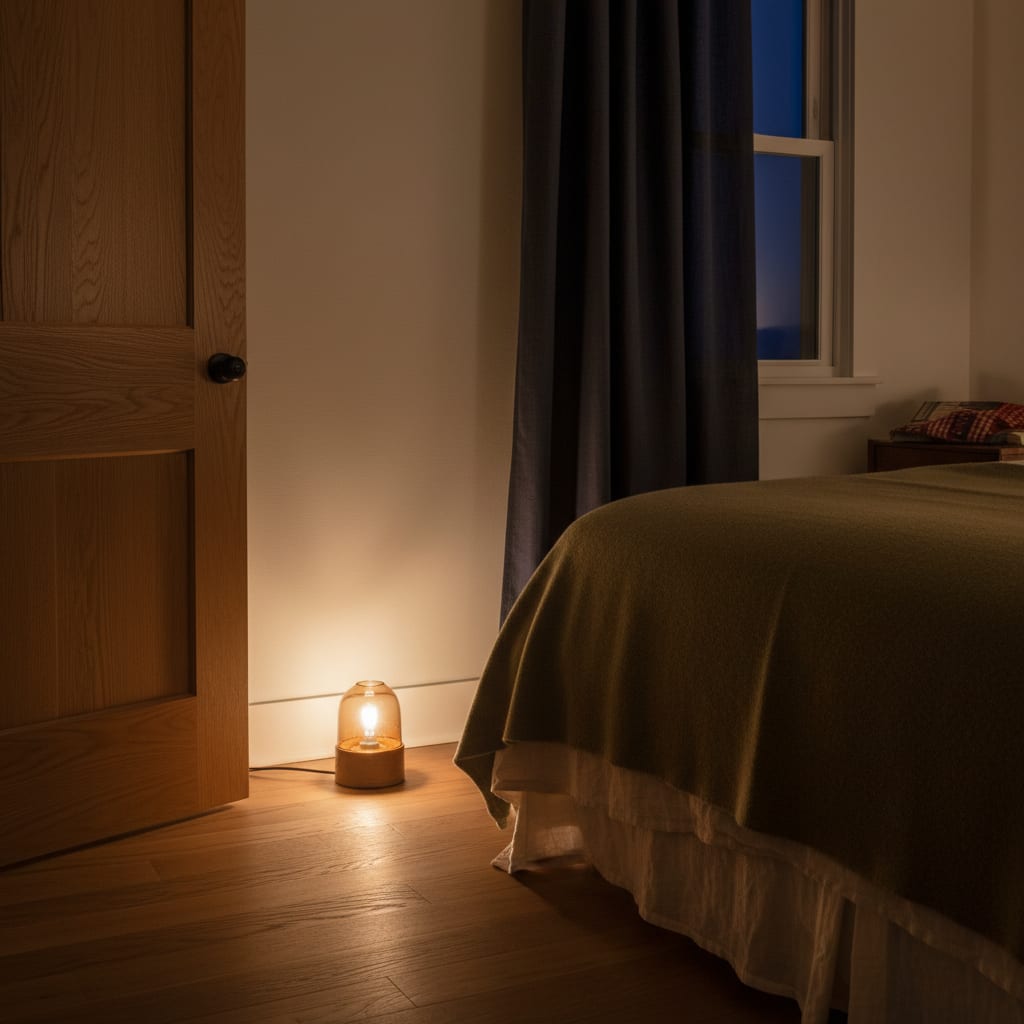
The light. Don’t touch the overhead switch. A dim plug-in night light set low near the floor, placed by the at-home parent at bedtime, lets you see the floor without lighting the bassinet. Stand in the hall for a few seconds first so your eyes adjust to the dark.
The noise. A sound machine running at a steady level from bedtime until morning covers the small sounds of a late entry: the door, the floorboards, a cough. The key is that it runs every night, not only the nights someone comes in late, so the room always sounds the same. A fan-based unit such as the Yogasleep Dohm does this with no screen and nothing to program. Place it between the door and the bassinet, so it sits in the path of the noise. The same idea, applied to a house where one parent sleeps by day, is in the two-clock night-shift house.
The bed
Set the room up so the late parent never passes the bassinet:
- Bassinet on the at-home parent’s side, away from the door, if the room allows it.
- The late parent’s side nearest the door, so the route from door to bed is short and doesn’t cross the baby.
- Sit, then swing in, in one movement. Not a slow creep that keeps the mattress creaking for a minute.
- No talking. If you need to hand over news from the day, it can wait for morning. A whispered conversation is still a conversation.
When the baby stirs anyway
Wait before you do anything. Babies are noisy sleepers, and the grunting and squirming of a baby in light sleep often settles again on its own. Picking up a baby who wasn’t fully awake is the most common way a late arrival turns into a 2330 feed.
If the baby really does wake, decide in advance who answers. Often the at-home parent is the one the baby expects at night, and it’s quicker for them to settle the baby than for you to try. On other nights you may want to take it so they can sleep. Either works, as long as it was agreed before 2300 rather than discussed in whispers over the bassinet.
A safety line for the tired parent
The late parent is usually the most tired person in the house, and that’s when the riskiest choices look reasonable. The AAP is specific about it:
- Never doze off holding the baby on a sofa or armchair. The AAP says the risk of sleep-related infant death is “up to 67 times higher when infants sleep with someone on a couch, soft armchair or cushion.”
- Don’t bring the baby into bed to sleep, especially when you’re exhausted. The same guide says the risk is “more than 10 times higher” for babies who bed-share with someone who is fatigued.
- If you bring the baby into bed to feed or comfort them, the AAP says to “place them back in their own sleep space before you go to sleep.”
If you’re too tired to trust yourself holding the baby, don’t hold the baby. Hand off, or put them back down.
Should you move the bassinet out?
For a baby under six months, the AAP’s answer is to keep the baby in your room. So the honest options, when the late entry keeps waking the baby, are:
- Move the bassinet within the room, further from the door and the late parent’s side.
- The late parent sleeps elsewhere on late nights, in a spare bed or on a made-up mattress, and rejoins on ordinary nights. This isn’t a bad sign for anyone. It’s a scheduling decision, and you can say so out loud.
After six months, moving a baby to their own room becomes a personal choice, and the trade-offs of a separate room are worth reading before you decide. Keep the bedtime routine identical, so only the room changes.

FAQ: coming to bed late with a room-sharing baby
How do I get into bed without waking my baby?
Do everything noisy outside the room first, go in by a dim floor-level light, keep a sound machine running all night, take the side of the bed nearest the door and away from the bassinet, and get in with one movement. If the baby stirs, wait before responding.
Should I move the baby out of our room because I come home late?
Not under six months. The AAP advises room-sharing for at least the first six months. Move the bassinet further from the door, or have the late parent sleep elsewhere on late nights. After six months, a separate room is a personal choice.
Is it safe to hold the baby on the couch when I get home late?
Holding the baby while you’re awake is fine. Falling asleep with them on a couch or armchair is not: the AAP says it raises the risk of sleep-related infant death up to 67 times. If you’re exhausted, put the baby back in their own sleep space.
Who should settle the baby if they wake when I come in?
Agree on it before the late night, not at 2300. Often the at-home parent settles fastest, but it can alternate. What matters is that nobody negotiates over the bassinet.