Military Family Life · Entry
What Is a Blue Star Family? The Banner and What It Means
A Blue Star family has a member serving in the US Armed Forces. What the Blue Star Service Banner means, who may display it, its history and the gold star.
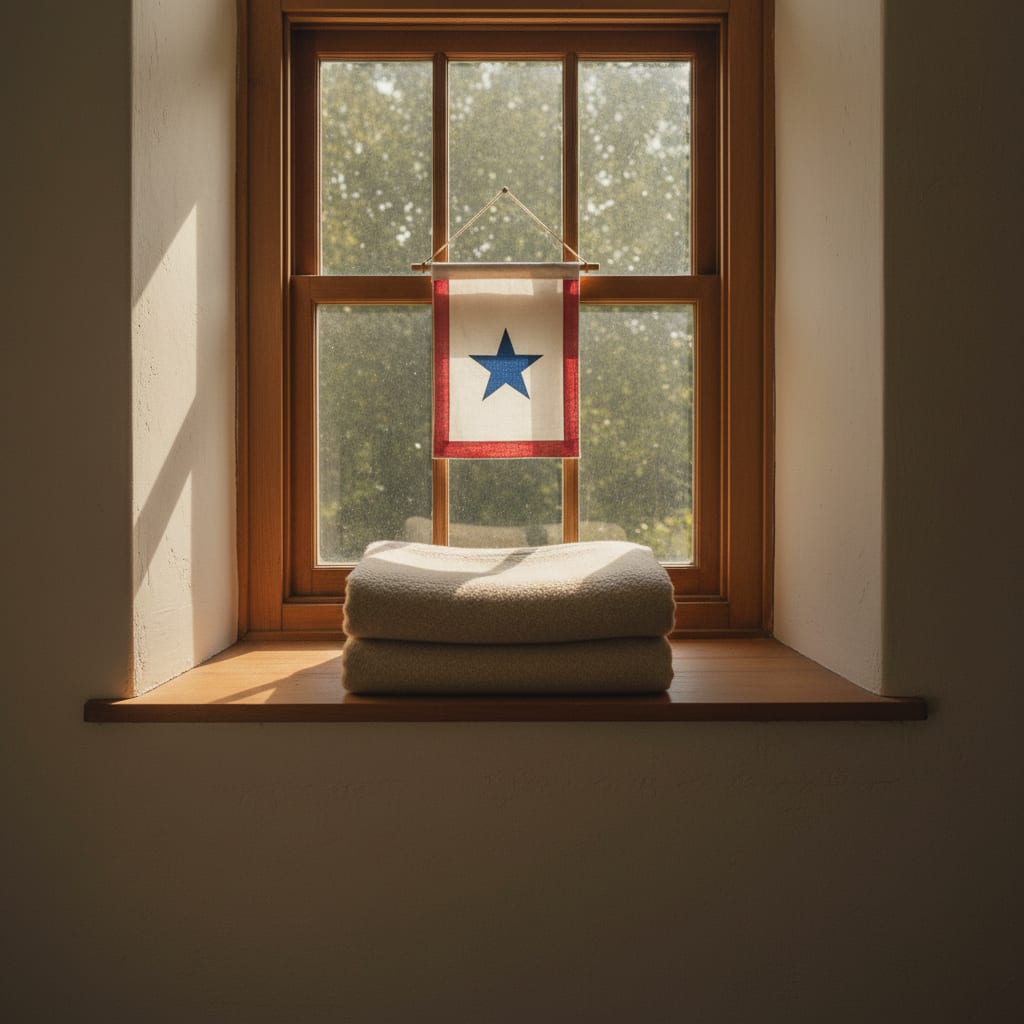
A Blue Star family is a family with a member serving in the US Armed Forces. The name comes from the Blue Star Service Banner: a small flag with a white field, a red border and one blue star for each family member in service, hung in a window of the family’s home. It dates to World War I. If a service member dies, a gold star is added, and the family becomes a Gold Star family. Displaying the banner is optional, and federal law and Defense Department rules set out which relatives may display it and when.
The Blue Star Service Banner
The National WWI Museum and Memorial gives the plainest description on its page about the service flag (loaded November 19, 2026): “With a white field, a red border and one blue star representing each family member in service, the Blue Star flag is a powerful patriotic symbol.”
The American Legion Auxiliary’s Blue Star Banners page adds that a banner “can have up to five stars, according to The American Legion.” So a family with two children in service hangs one banner with two stars, not two banners.
The banner’s traditional place is a window of the family home. It is a quiet signal to the street that someone from this house is serving. The Auxiliary page puts it this way: “the Blue Star Service Banner is a reminder that war touches every neighborhood.”
Where it came from
The banner is older than most people assume. According to both pages, it was designed and patented in 1917 by Army Captain Robert L. Queisser of the 5th Ohio Infantry, whose two sons were serving in World War I. (The spelling of his surname varies between sources; both pages use Queisser.) The WWI museum says the design “soon became the unofficial symbol for a child in service.”
The gold star followed a year later. In 1918, the museum says, a women’s committee asked President Woodrow Wilson to allow mothers who had lost a son to sew a gold star onto the black mourning bands of the time. He approved it, and the practice moved onto the service flag: a gold star stitched over the blue one.
Families made these banners by hand, so they varied. The museum notes that some sources say the gold star should cover the blue completely, while surviving examples often show a thin blue border around the gold. Today, it says, “most official gold star service flags now feature a gold star taking a position of honor above the blue star instead of covering it.”
The Legion Auxiliary credits The American Legion with helping bring the banner back into wide use after the September 11 attacks, by providing banners to military families across the country.
Who may display it
Federal law covers the banner at 36 U.S. Code § 901. It says an approved service flag “may be displayed in a window of the place of residence of individuals who are members of the immediate family of an individual serving in the Armed Forces of the United States during any period of war or hostilities in which the Armed Forces of the United States are engaged.”
Three things follow from that sentence:
- It is optional. “May be displayed.” No family is required to hang one.
- It belongs to the family at home. The banner is for the people at home, not for the service member, who serves rather than displays.
- It is tied to periods of war or hostilities. The WWI museum summarizes the Defense Department’s position as families “have the option of displaying the flag in a window for the duration of any conflict involving the United States.”
On who counts as immediate family, the museum lists the relatives the Defense Department now authorizes to display it: “wives, husbands, mothers, fathers, stepparents, adoptive parents, foster parents, children, stepchildren, adoptive children, brothers, sisters and half-siblings.” The same law also covers a matching service lapel button, and says banners and buttons are made under license. If the detail matters for your family, check current Defense Department guidance rather than relying on a summary.
Blue star, gold star
- Blue star: a family member is serving now. The museum says the blue star “symbolized hope and pride.”
- Gold star: a family member died in service. The Legion Auxiliary says a smaller gold star is placed over the blue one, and that on a banner with several stars, gold stars go “above the blue stars or to the top right of the flag.”
The words “Gold Star family” carry real weight in the military community. In a Blue Star house, it is worth knowing the difference before a child asks about a neighbor’s flag.
Explaining the banner to your kids
Military kids notice flags. A blue-star banner in your own window, or in a neighbor’s, is an easy way into a conversation about what the serving parent does.
- Under five. “The blue star means someone in our family is in the military. That’s Daddy.” Let them count the stars.
- Five to eight. Tell them the 1917 story: a dad whose two sons went to war made a flag with a star for each of them, so the whole street would know. Kids like that a real person invented it.
- The gold star question. If they see one, keep it simple and true: “That family’s person died while they were in the military. The gold star means we remember them.” You don’t need to go further unless they ask.
Hanging the banner can be a small family ritual at the start of a deployment, alongside the countdown. Our posts on what military life gives your kids and on Veterans Day for kids pair well with it, and Military Family Appreciation Month in November is a natural time to talk about it.
There are also nonprofit groups that use “Blue Star” in their names. They are separate organizations with their own programs. The banner and the phrase “Blue Star family” belong to every family with someone serving, and no membership is needed.
FAQ: Blue Star families
What does a blue star in a window mean?
That someone from that household is serving in the US Armed Forces. Each blue star on the banner represents one family member in service.
How many stars can a Blue Star banner have?
Up to five, according to The American Legion as quoted by the American Legion Auxiliary. Each star stands for one serving family member.
What is the difference between a Blue Star and a Gold Star family?
A Blue Star family has a member serving now. A Gold Star family has lost a member who died in service, and a gold star is added to their banner.
Do I have to display a Blue Star banner?
No. Federal law says the banner “may be displayed” by eligible immediate family members. It is entirely your family’s choice.