Kids' Sleep in Winter Darkness at a Northern Duty Station
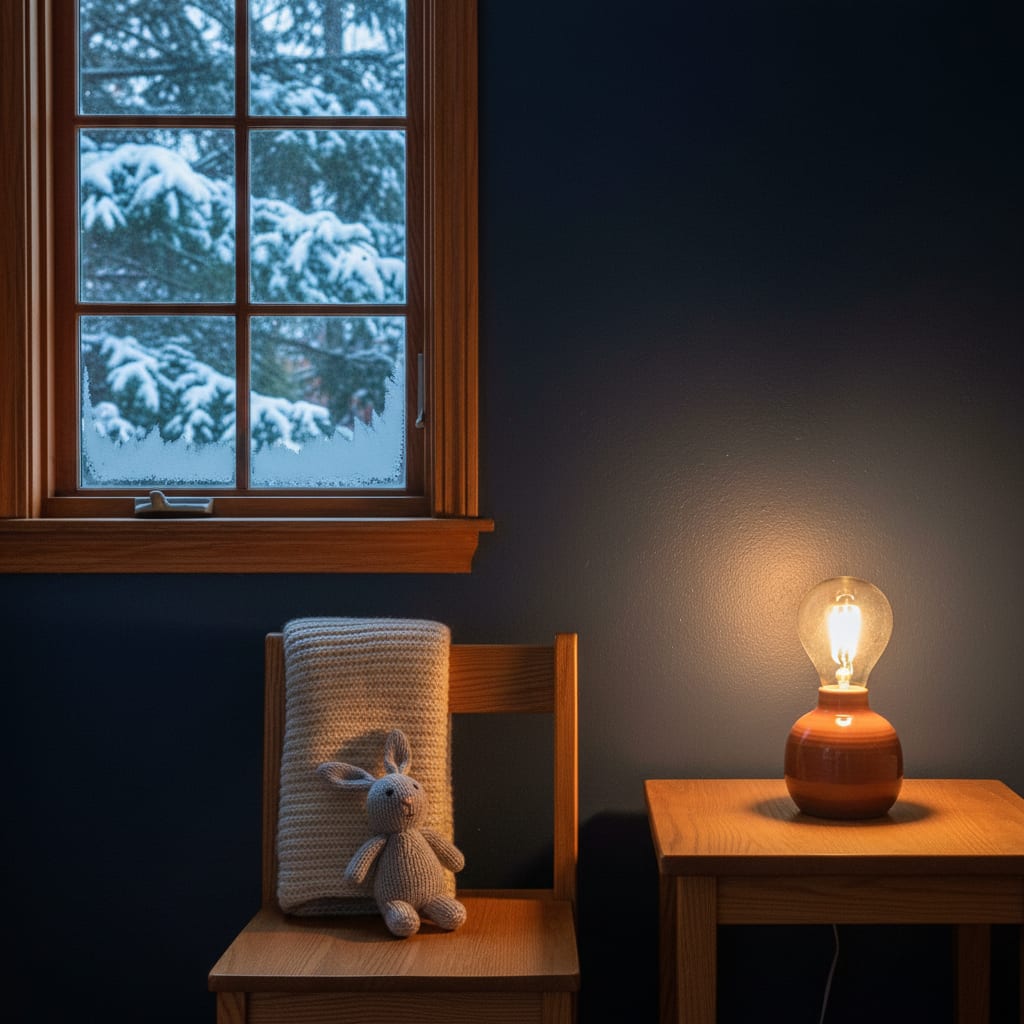
At a northern duty station in winter, the sun stops running your child’s schedule, so the house has to do it instead. Keep the same wake-up and bedtime every day, whatever the sky is doing. Put bright light on the minute your kid gets up, and get outside in whatever daylight there is around midday. Don’t let a dark 4 p.m. turn into a nap or an early bedtime, and dim the house only in the last hour before bed. Then keep the bedroom about 68 to 72°F and add warmth with sleepwear, not blankets.
Why a dark winter scrambles a small kid’s clock
Light is the main signal a body uses to set its day. The National Institute of General Medical Sciences says it directly: “Light and dark have the biggest influence on circadian rhythms,” and the brain’s master clock “controls production of the hormone melatonin based on the amount of light the eyes receive,” with more melatonin in the evening “causing sleepiness” (NIGMS, Circadian Rhythms fact sheet).
Most families don’t have to think about that, because the sun keeps the cue roughly where the household wants it. Far enough north, it doesn’t. In interior Alaska, the University of Alaska Fairbanks’ Geophysical Institute describes the winter-solstice sun as visible for “3 hours, 41 minutes” from a hill above Fairbanks (Alaska Science Forum, December 2020). Stations farther south get more daylight than that, but anywhere well north the pattern is similar in a milder form: dark at breakfast, and dusk by mid-afternoon.
That plays out in a small kid in two familiar ways. The first is a kid who won’t get up in the dark and is cranky until it’s light. The second is a kid who melts down at 1600 because the house feels like bedtime.
If you’ve just arrived, this lands on top of a move. The first weeks after a PCS already unsettle sleep; the week-by-week bedtime plan after a move handles that part. This post is about the season.
Mornings: the lights are your sunrise
The American Academy of Pediatrics advises keeping “The same waking time (both on weekdays and weekends),” and to “Expose children to bright light when it’s time to get up to help stimulate wakefulness” (HealthyChildren.org, Healthy Sleep Habits, last updated 8/7/2026). In a northern winter, that light comes from your light switches.
- Pick one wake-up time and hold it, including weekends. Without a sunrise to anchor the day, the wake-up is what anchors it.
- Turn the main lights on at wake-up, kitchen included. A toddler eating breakfast under one dim lamp is getting the bedtime cue at the wrong end of the day.
- Give an early riser something to wait for. Pre-dawn and dark-morning wakings look the same to a three-year-old. A time-to-rise light such as the Hatch Routine Builder changes color at the time you set, so “wait for green” replaces “wait for the sun”, which isn’t coming until mid-morning.
If your kid is waking before you want them up even with the house dark, check the cause before you blame the season. A household alarm or a pre-dawn PT departure can wake a child more reliably than daylight does; that’s covered in early waking on a duty schedule.
Midday: spend the daylight outside
The AAP’s same page calls for “interesting and varied activities during the day, including physical activity and fresh air.” In midwinter at a northern post, there may only be a few hours of daylight, often around lunch. Plan the outdoor time for then, not for after daycare, when it’s already dark.
It doesn’t have to be long or ambitious: a walk to the mailbox, a snow shovel each, the playground for twenty minutes. Dress for the actual temperature, and come in if your kid is getting cold. On days that are too cold or stormy to go out, put the active play by the brightest window in the house.
The 4 p.m. slump: don’t let dusk set bedtime
This is where a northern winter catches most families. It gets dark mid-afternoon, a toddler’s energy dips, and the house starts to feel like evening. If they fall asleep on the sofa at 1630, they’ll be up again at 2000. If you move bedtime earlier and earlier to match the dark, you’ll get a 0500 wake-up.
- Don’t move bedtime because it’s dark. Keep bedtime at its clock time.
- Keep the lights up until dinner, then start dimming. The AAP’s advice is to “Dim the lights prior to bedtime,” so do that in the last hour, not when the sun goes down.
- Watch for a late nap. A car ride home from daycare in the dark is the classic trap. Sing, talk, crack a window, or leave a snack for the drive.
- Keep screens out of the last hour. The AAP recommends turning off all screens “at least 60 minutes/1 hour before bedtime.” On a long dark evening it’s tempting to fill the gap with a show. Use something with a book or a building set instead.
If you aren’t sure how much sleep your child needs at their age, Betteroo’s sleep-by-age chart gives the ranges. It’s a good way to check whether a cranky afternoon is too little sleep or just a dark afternoon.
The bedroom: warm the child, not the room
In a cold winter the instinct is to turn the heat up and pile on blankets. The AAP’s guidance points the other way: “avoid overheating” and keep temperatures “between 68°F to 72°F for infants and children.” Betteroo’s pediatrician-reviewed temperature guide gives the same range and suggests adjusting with sleepwear layers rather than blankets. It also suggests keeping the crib away from a radiator or a cold draft.
- Measure, don’t guess. A small room thermometer, such as the Govee H5075, tells you whether the room really is cold or whether it’s the floor that’s cold.
- For babies, use layers or a wearable blanket, never a loose one. The AAP says that “If you’re worried about your baby getting cold, you can dress them in layers of clothing or use a wearable blanket,” and “In general, you should dress your baby in only one layer more than you’re wearing.” No blankets, pillows or quilts in the crib (HealthyChildren.org, How to Keep Your Sleeping Baby Safe). A fleece sleep sack such as the HALO Sleepsack Micro-Fleece is one option for a cooler room.
- Keep the room dark at night and bright in the morning. Thick curtains help with streetlights and snow glare, but open them, and turn the lights on, at wake-up.
When the parent at home is running winter solo
If the other parent is away for part of the winter, all of this falls to one adult in the darkest weeks of the year. Write the day down once (wake-up, lights on, outdoor window, dinner, lights down, bedtime) and run it the same every day. Fewer decisions are easier on a tired parent, and the routine gives the kids the structure the daylight isn’t giving them.
 A schedule that doesn't need the sun
Betteroo builds a nap-and-bedtime plan for your child's age, so the clock runs the day when the daylight can't.
Take the 3-minute sleep quiz →
FAQ: kids’ sleep in a northern winter
Should bedtime be earlier when it gets dark so early?
Usually not. Keep bedtime at its clock time and keep the house bright until dinner. Moving bedtime earlier to match the dark tends to move the wake-up earlier too. If your child is genuinely short on sleep, adjust bedtime in small steps for that reason, not because of the dark.
How do I get my toddler up when it’s still dark?
Turn the main lights on at the set wake-up time, every day, and make breakfast happen under them. The AAP recommends bright light at wake-up to help stimulate wakefulness. A time-to-rise light gives a small child a clear signal that it’s morning.
What temperature should my child’s room be in winter?
About 68 to 72°F, per the AAP. Keep the room in that range and adjust warmth with sleepwear layers or a wearable blanket for babies, not loose blankets.
Is it normal for kids to seem low in a long, dark winter?
Some crankiness in the darkest weeks is common, and routine and daylight help. If your child seems persistently sad, withdrawn or tired whatever you do, or their sleep keeps getting worse over several weeks, talk to your pediatrician.