Deployment Activities for Kids: Crafts and Connection
The best deployment activities for kids do one of two jobs: they make the time visible and shrinkable (countdown crafts), or they keep the missing parent woven into daily life (connection games). You don’t need a Pinterest board’s worth — you need one countdown ritual, one or two connection habits, and a weekly anchor event, all welded to times of day the kids can predict. Everything below is sorted by which job it does and how much energy it costs the parent running the homefront, because that parent’s energy is the scarcest resource in the operation.
Countdown crafts: making the time shrink
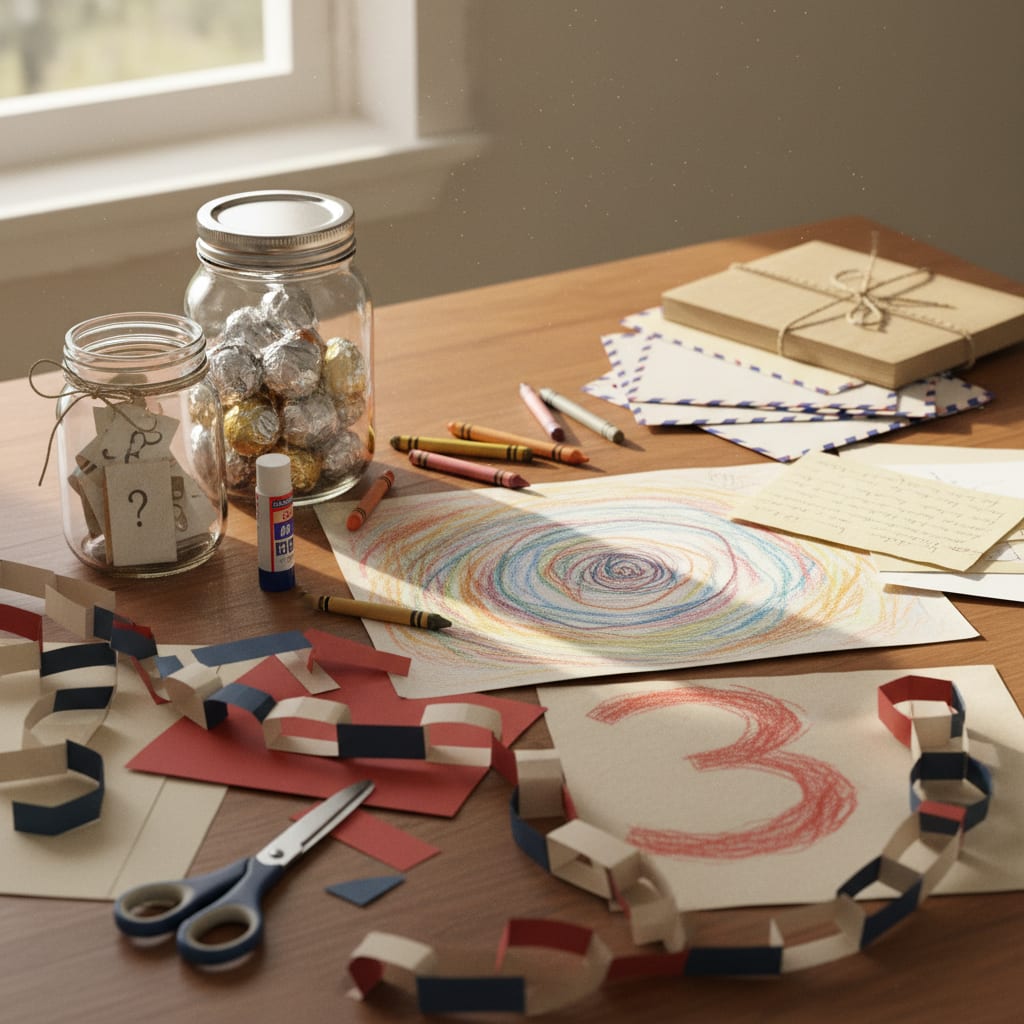
The heavy hitters are covered move-by-move in the deployment countdown ideas post — paper chains, kiss jars, sticker paths, map trackers — so here’s the command summary: pick ONE, make the kid its official operator, and run it at the same moment every day. The craft session where you build it is itself a top-tier deployment activity: a rainy Saturday spent cutting fifty paper links or painting a jar is an hour of talking about the deployment with hands busy, which is exactly when kids talk best. Build spare capacity in from the start — extra links in a drawer, a jar that’s “almost empty” rather than a circled date — so a shifted timeline is an adjustment, not a betrayal.
Connection activities: keeping the parent in the room
- The two-copy book club. Two copies of the same picture book — one stays home, one deploys. The parent away reads it on video or a recording; the kid follows along in their copy at bedtime. Costs two paperbacks, works at any distance, survives terrible internet.
- The question jar. Kids drop questions in a jar all week (“what do you eat?” “did you see a shark?”), and they get asked in a batch whenever a call lands. Takes the pressure off live calls — no more four-year-old freezing on the phone — and gives quiet weeks a purpose: the jar keeps filling.
- Joint art, split screen. Kid draws a picture, photographs it (or you do), sends it; the deployed parent draws an answer when they can. Stick the gallery on the fridge. Half our fridge became an extended argument about whether a dinosaur could beat a submarine, which I consider peak family correspondence.
- The highlight-reel chain. The reverse paper chain: kids ADD a link each day with one thing to tell the deployed parent — lost tooth, saw a snake, learned to whistle. By homecoming you’ve built a physical scroll of everything they missed — and it pairs perfectly with open-when letters flowing the other direction.
- Care-package build days. Let the kids own part of every box — drawings, a joke written on the flap, the candy quality-control department. The full packing doctrine is in the care package ideas post; the activity value is that assembling a box converts missing-someone into doing-something.
Solo-day activities that buy the homefront parent oxygen
Some deployment activities exist for the honest reason that one adult is running a multi-kid operation for months. Keep a short bench of low-effort, high-absorption options: a “yes bin” of craft supplies that only comes out on hard afternoons, sidewalk-chalk obstacle courses, a flashlight fort with the recorded story playing, bath time promoted to an event with glow sticks. None of these are deployment-themed, and that’s the point — normal fun is a deployment activity too. A kid whose week still contains ordinary delight is a kid whose deployment is going as well as it can.
The weekly anchor: give the week a shape
Days have bedtime as their anchor; weeks need one too. Ours is family movie night — same night, blankets on the floor, occasionally synced with the deployed parent watching the same film on their end. Yours could be Saturday pancakes, Sunday park patrol, Friday pizza-and-fort. The content matters less than the drumbeat: during a deployment, “how many movie nights until Dad’s back?” becomes a countdown a preschooler can actually hold. The whole-cycle context for all of this — goodbye through homecoming — is in the deployment guide for dads.
Matching activities to ages
Under three: tactile and repeated — sticker paths, the recorded story on loop, splashy bath events. They need ritual, not novelty. Preschoolers: give them ownership — the countdown is THEIRS, the question jar is THEIRS, and they will enforce this with the zeal of a junior customs inspector. School-age: give them production jobs — running the highlight chain, filming a weekly one-minute “news report” for the deployed parent, planning a care-package theme. Older kids engage when the activity produces something real that gets sent, kept, or shown at homecoming.
FAQ: deployment activities for kids
What are the best deployment activities for a toddler?
One simple daily countdown (sticker path or paper chain, hand-over-hand), a recorded story or song from the deployed parent played at the same time every day, and steady ordinary fun. Toddlers don’t need deployment-themed enrichment — they need rhythm with the missing parent’s voice inside it.
How do you keep kids connected to a parent with bad or rare communication?
Build the connection on things that don’t need a live signal: recordings made before departure, the two-copy book club, the question jar that saves up for whenever a call lands, and letters both directions. Frame quiet stretches as normal (“busy, or bad internet”) so silence never reads as something wrong.
How many deployment activities should you actually run at once?
One daily countdown, one or two connection habits, one weekly anchor. That’s the whole stack. A wall of half-abandoned crafts teaches kids that the deployment systems fizzle; three small rituals that never miss teach the opposite, and cost a tired solo parent far less.
Do deployment activities actually help kids cope?
They help with the two things little kids struggle with most: time (made visible by countdowns) and absence (made smaller by connection rituals). They’re not magic and they don’t replace steady routines or honest answers — but a kid with a job, a rhythm, and a shrinking chain has handles to hold that a kid without them doesn’t.