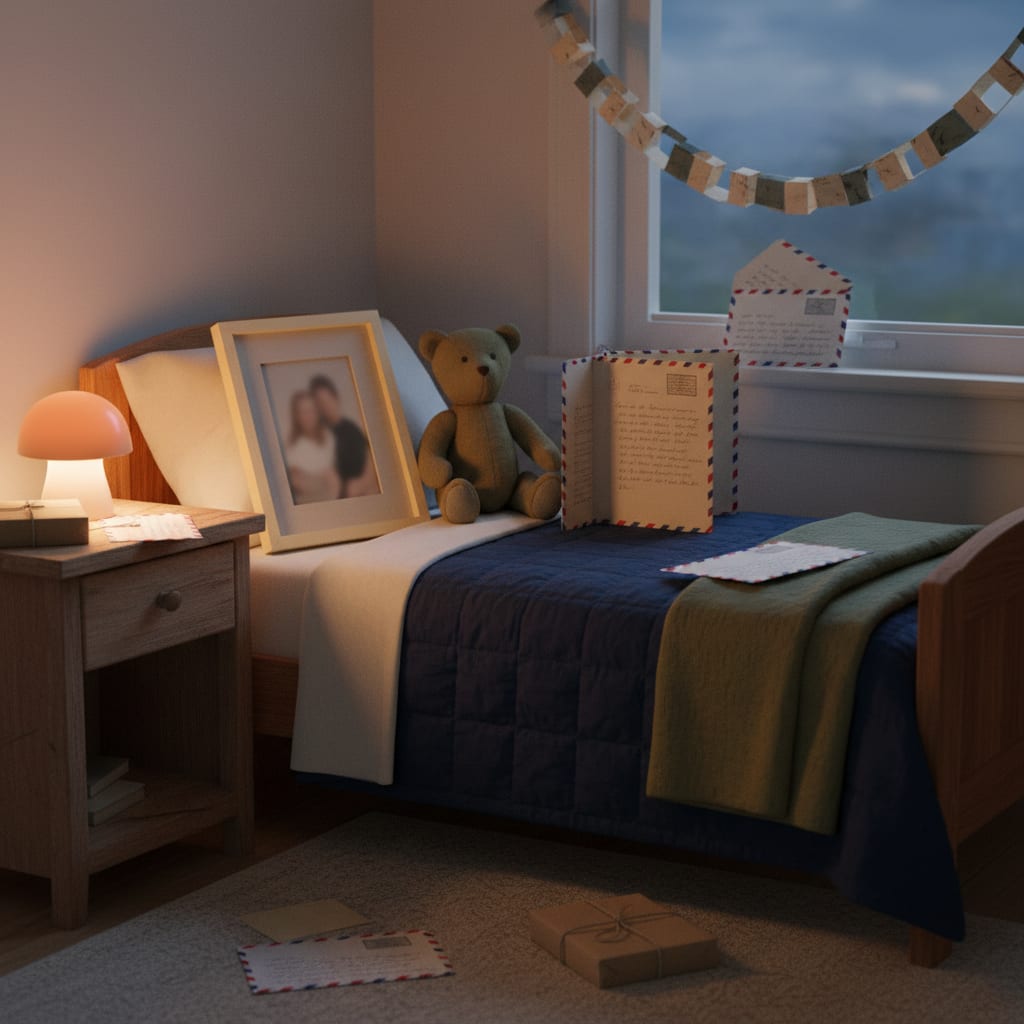
Holidays During Deployment: A Plan for Military Kids

Holidays during deployment go best when both parents plan them before the goodbye. The deploying parent records a story and a carol, wraps and labels gifts, and agrees a call window that suits both time zones rather than promising “Christmas morning.” The parent at home keeps two or three traditions that matter to the kids, drops the rest without guilt, and gives the absent parent a visible place in the day. Small children take their cue from the adult running the house: a calm, cut-down holiday beats a full one held together by willpower.
Most holidays-during-deployment advice is written for the spouse at home. This page covers both seats, because most military dads sit in each of them at some point.
Seat one: the parent who will be away
The work you do before you leave is the only holiday work you control. Once you’re gone, mail is slow, calls drop and the schedule belongs to someone else. So front-load it.
Record before you go. Read the book your family reads on Christmas Eve (or the Thanksgiving one, or whatever your household’s equivalent is) and sing one carol, badly if necessary. A phone video works; a recordable storybook works better for a toddler, who can press the button forty times on the day without anyone needing the charger. Record a second short message just for the morning itself: “Merry Christmas, I’m thinking about you right now.” Kids under five don’t care that it was recorded in October.
Wrap and label the gifts now. Buy, wrap and label them from you, then hide them with the other parent. Write the labels in your own handwriting. A four-year-old can’t read it, but the parent at home can say “Dad wrote this,” and that lands.
Write one letter for the day. Short, specific and about them: the thing they did last Christmas, the thing you’ll do together next year. Put it in an envelope marked for the morning. Two or three sentences is plenty for a preschooler.
Agree the call plan before you leave, not on December 23. “I’ll call Christmas morning” is a promise to a child that the time zone, the mission and the connection can each break. Instead, agree a window with the parent at home: a day or two either side, at a time that’s sensible in both places. Christmas Eve evening at home might be the middle of the night where you are, or the next morning. Work it out in advance. The bedtime video calls guide has the time-zone arithmetic and a call shape that ends calmly rather than in tears. Tell the kids “Dad will try to call around Christmas,” not a time, and anything you manage is a bonus rather than a broken promise.
Mail early, and mail small. If you want a box to reach home from where you are, mail it early. For the box going the other way, the Christmas care package guide has the 2026 USPS military send-by dates and what to pack.
Seat two: the parent running the holidays at home
You are about to do the most logistics-heavy month of the year with one fewer adult. The goal is not to replicate last year; it’s to get everyone through December with the traditions that matter intact.
Keep three traditions, drop the rest
Sit down in November and list every holiday thing your family does. Then pick the two or three your kids would actually miss. For small kids, that’s usually something like the tree, one special meal and one night-before ritual. Keep those, and do them properly. Everything else, from the cards to the cookie marathon to the second party, is optional this year. Nobody remembers the year you didn’t send cards. They remember the year the house felt calm.
Give the absent parent a place in the day
Small children do better with something they can see than with an idea, so make the absent parent visible:
- A photo at the table for the holiday meal, at their usual seat.
- An ornament that’s theirs. A handprint ornament from each kid, with a matching one mailed to the deployed parent, means the same thing is hanging on both trees. Betteroo’s list of Christmas crafts small kids can actually manage has handprint and salt-dough versions sorted by age.
- Their gifts opened last, with their recorded message played first.
- A short daily countdown to the call window, not to the homecoming. A homecoming date may move. A call window is closer and you control it.
When a kid refuses a tradition
Expect at least one child to refuse something that used to be Dad’s job: the star on the tree, carving, reading the Christmas Eve story. It’s rarely about the tradition. It’s “that’s Dad’s,” which is loyalty, not defiance. Don’t force it and don’t hand it to someone else. Offer two choices: “We can save the star until Dad’s call and he can tell you when to put it up, or you can do it and we’ll send him the video.” Most kids take one of them. If they take neither, leave the star in the box this year. It’ll keep.
Say yes to help, and say it early
Invitations come in November. Accept the ones that come with someone else’s kitchen and turn down the ones that need you to host. If grandparents offer to visit, get a firm date before December fills up. This is the month the people who offered help at the goodbye were offering it for.
Look after the solo parent
You’ll be tired, and the holidays add late nights, sugar and excited kids to that. Protect bedtime on most nights and plan one or two late ones, rather than letting every evening drift. Get the gifts done by mid-December so the last week is for the kids, not for shopping. And give yourself a small something that’s yours: an hour, a walk, a phone call with another military spouse who gets it.
Thanksgiving comes first
Thanksgiving is the rehearsal, and it’s on November 26 this year. Use it to test the system before Christmas: the call window, the photo at the table, the cut-down menu. If the call doesn’t happen, notice how the kids handle it and adjust what you say before December. If Thanksgiving felt like too much, cut harder for Christmas.
What to tell the kids
Keep it simple and true: “Dad is working far away this Christmas. He can’t be here, and he’ll be thinking about us all day. We’ll open his presents and listen to his story.” Avoid promises about the call time and about the homecoming, and avoid “home by Christmas” unless it’s certain. Explaining deployment to a child covers why. Kids handle an honest plan far better than a hopeful one that falls through.
And if the day goes sideways, with a meltdown at the table or a call that drops after ninety seconds, that’s a normal deployment Christmas, not a failed one. The kids will remember that the presents had Dad’s handwriting on them.
FAQ: holidays during deployment
How do you celebrate Christmas when a parent is deployed?
Keep the two or three traditions your kids care about most, give the deployed parent a visible role (a recorded story, gifts they wrapped before leaving, a photo at the table) and plan a call window around the time zones rather than a single moment. Drop everything else that adds stress.
Should we wait to celebrate until the deployed parent is home?
Not for small children. Celebrate on the day, then plan a small second celebration at homecoming, such as a saved present or a late tree-trimming. Young kids find a holiday postponed for months hard to understand.
What should the deploying parent do before leaving?
Record a story and a holiday message, wrap and label gifts, write a short letter for the day, and agree a realistic call plan with the parent at home before departure.
How do I help my child if the holiday call doesn’t happen?
Say so plainly and early, and have the recorded message ready to play instead. If you’ve told the kids “Dad will try to call around Christmas” rather than naming a time, a missed call is a disappointment, not a broken promise.