Homefront Dad · Entry
Reveille and Taps on Base: Helping a Light Sleeper
Reveille waking your child at dawn, or Taps at night? How base bugle calls meet a light sleeper in on-base housing, and what to change in the bedroom first.
If reveille or taps keeps waking your child in on-base housing, start with three things: find out the exact times the calls play on your installation, move the child’s sleep space to the room farthest from the nearest speaker, and set up the room for the call that actually wakes them. Reveille lands in the early-morning stretch when sleep is lightest, so darkness and steady background sound matter most there. Taps usually falls after a young child’s bedtime. If the volume is the problem, tell the installation: at least one garrison turned the speakers in its housing areas off after residents spoke up.
What the bugle calls are and when they play
The bugle calls are an everyday part of installation life. US Army Garrison Stuttgart’s public affairs office explained them for residents in an article on what to do when you hear bugle calls (February 26, 2025):
- Reveille, in the morning, “signals the raising of the American flag and roll call.”
- Retreat and To the Colors, together, signal “the end of the workday.”
- Taps “is played alone at the end of the day to honor service members who paid the ultimate price.”
At that garrison, the schedule published with the article was 0630 for reveille and 2200 for taps. Your installation’s times may be different. Before you change anything at home, find your own schedule. The installation public affairs office, housing office or the installation’s website is the place to ask.
Write the times down. You can’t plan around a time you are guessing at.
Why reveille is the one that wakes kids
A call at 0630 on its own sounds harmless. The trouble is when it lands.
Betteroo’s guide to why a child wakes before the household is ready explains that “the last stretch of the night, roughly from 4 to 6 am, is dominated by light sleep,” and that by then “any small disruption, light, noise, hunger, or a sleep association, can tip your baby into waking instead of resettling.” It notes that waking between 6 and 7 am is normal for many babies, while a consistent wake before 6 is what counts as early.
So a reveille time that sits inside or close to that light-sleep stretch can end the night for a child who would otherwise have drifted on for another half hour. A loud, sudden sound is exactly the kind of disruption it describes.
The American Academy of Pediatrics makes a related point on how noise affects children: research mainly in adults “shows that even low levels of nighttime environmental noise cause more body movements, awakenings and other sleep disturbances,” which happen “even though the sleeping person is not aware of them.”
If your child’s wake-up time has crept to match the reveille time exactly, that is your clue.
Why taps is usually the smaller problem
Taps at the end of the day usually comes well after a young child has gone to bed, rather than in the light early-morning stretch. For a toddler with an early bedtime, taps may pass unnoticed.
It matters more for:
- Babies with a late last feed or a dream feed close to the taps time.
- Older kids with a later bedtime, who may be just drifting off when it plays.
- Children who share a room with a sibling who wakes and sets them off.
If taps is the one that gets you, the fix is usually moving the last feed or the bedtime a little, not changing the whole night.
What to change in the bedroom
Start with the cheapest, quietest changes.
- Pick the room farthest from the speaker. Walk outside and find out where the sound comes from. In a two- or three-bedroom unit, the child closest to it is often the one who wakes. Swapping rooms costs nothing.
- Close the windows on the speaker’s side at night. A closed window is a cheap first barrier.
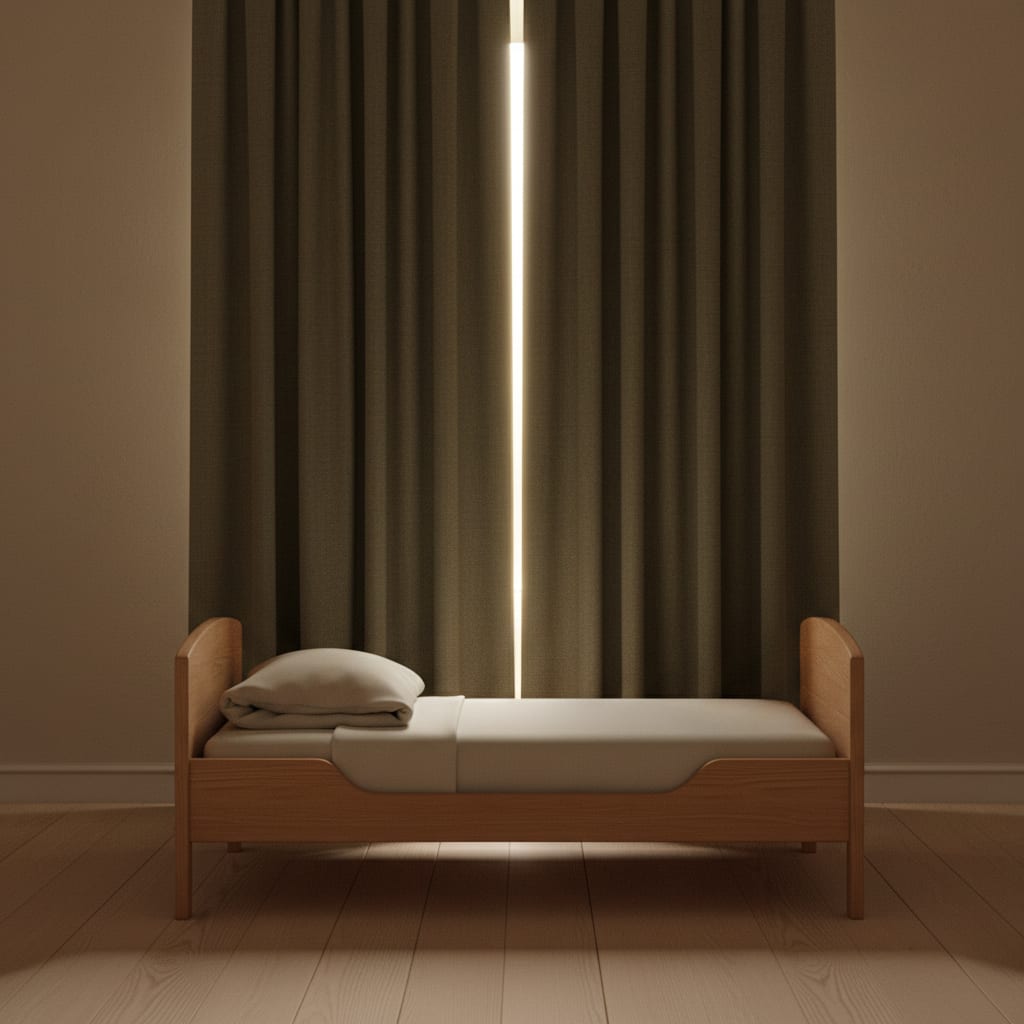
- Darken the room for the morning. Betteroo’s early-waking guide recommends darkening the room completely “with blackout coverings so early light does not signal morning.” A child woken by reveille in a bright room is much harder to settle back than one in a dark room.
- Use background sound carefully. A fan-type machine like the Yogasleep Dohm Classic can blur the edge of a distant call. Follow the AAP’s advice: “place it as far away from the baby’s head as possible,” keep it low, and never turn it up to try to drown out a bugle. Our post on jet noise and baby naps on base covers sound machines and on-base noise in more detail.
- Treat a reveille wake like a night waking. Keep the lights off and the interaction quiet until your chosen wake-up time. The Betteroo guide suggests holding the room “dark and calm” and waiting until your target start time, “even by 15 or 20 minutes at first.”
Adjusting the schedule
If the room changes aren’t enough, look at the schedule.
- Keep one wake-up time. The AAP’s healthy sleep habits page (last updated 8/7/2026) recommends “the same waking time (both on weekdays and weekends).” If reveille is close to when your child would wake anyway, sometimes the easiest plan is to accept it as the start of the day.
- Check bedtime. Counterintuitively, the Betteroo guide says a bedtime that is too late can cause early waking, and that moving bedtime earlier often helps. Give any change several days.
- Watch the first nap. If a reveille wake is followed by an early nap, the body can learn the early start as normal. The guide recommends holding the first nap until a set time for each schedule.
If your household already runs on early starts, our guide to early waking on a duty schedule covers mornings when a parent leaves before dawn.
Talking to the installation
Bugle calls are tradition, but volume and speaker placement are decisions, and installations do respond. The Stuttgart article says that “in response to feedback from our installation residents and members of the surrounding communities,” the garrison “turned off the sound system for all speakers that are in installation housing areas and turned the volume to a one (on a scale of 1-10) for all other speakers.”
If a speaker is pointed at your bedroom window, a polite note to your housing office or the installation’s public affairs office is reasonable. Note the times, the room and what happens.
If you’re still choosing where to live, add bugle-call speakers to the walk-through list alongside flight paths and traffic. Our comparison of living on base vs off base covers the rest of that decision.
Turning the calls into part of the day
For older toddlers and preschoolers, a sound they understand is less startling than one they don’t. Make the calls familiar:
- Name them. “That’s reveille, the good-morning song for the flag.” “That’s taps, the goodnight song.”
- Practice what to do. The Stuttgart article says civilians face the flag or the direction of the music for reveille and retreat, and put a hand over the heart during To the Colors. For taps, it says “there are no formal protocol procedures required,” but suggests remembering veterans and those who gave their lives. A preschooler can learn this at the end-of-day call when you’re outside together.
 Sleep that outlasts reveille
Betteroo builds a sleep plan for your child's age, with the bedtime, nap and morning timing that make an early bugle call easier to sleep through.
Take the 3-minute sleep quiz →
FAQ: bugle calls and kids’ sleep
What time is reveille on base?
It depends on the installation. One Army garrison published 0630 for reveille and 2200 for taps in 2025. Check with your own installation’s public affairs or housing office.
Can I ask the base to turn the bugle calls down?
You can raise it politely with the housing office or public affairs. At least one garrison turned off speakers in its housing areas and lowered the rest after residents gave feedback.
Should I use white noise to block reveille?
A sound machine can help soften a distant call, but follow the AAP: keep it as far from the child’s head as possible and never turn it up to compete with the bugle.
Will my child get used to the bugle calls?
Often the room changes are enough: a darker room, a sleep space farther from the speaker, and a call that has become a familiar sound. If early waking continues for weeks, look at bedtime and the first nap too.